Winter 2025 - Vol. 20, No. 4
SCIENTIFIC REPORT
19th-Century Mental Health Disorders and the American Civil War
Kenneth W. Lin, MD, MPH
Associate Director, Family Medicine Residency Program
Penn Medicine Lancaster General Health
John Mead, known as “Colonel” to visitors, lived as a hermit in caves and rock shelters along the Lancaster County side of the Susquehanna River from the late 19th century until his death in 1917. Although it is not known if Mead’s honorific accurately represented his military rank, he was a veteran whose unusual lifestyle was thought to be related to the mental health effects of service in the Civil War as a young man.
1
If so, he was one of many Pennsylvania veterans to have suffered from post-traumatic stress disorder (PTSD), which was not officially recognized as an illness until the third edition of the American Psychiatric Association’s
Diagnostic and Statistical Manual of Mental Disorders (DSM-III) in 1980.
2 This article explores the causes of and medical response to widespread psychological trauma resulting from the Civil War.
INVISIBLE WOUNDS
For most readers, the term “Civil War medicine” may likely evoke grisly images of blood-spattered bone saws and piles of amputated limbs in unsanitary field hospitals. Others might picture glass bottles of opium-containing concoctions dispensed liberally to treat diarrhea or other gastrointestinal ailments resulting from a diet of hardtack, salt pork, and coffee.
3
History buffs may have visited the National Museum of Civil War Medicine in Frederick, Maryland or watched episodes of the 2016-17 PBS television drama
Mercy Street, which depicts real and fictional characters treating battlefield wounds and infectious diseases at a Union military hospital in Alexandria, Virginia. For every Civil War veteran with a missing limb or other visible physical scar, however, others suffered from the “invisible wounds” of psychological illness from military service.
4,5
According to Binghamton University historian Diane Sommerville, not only did 19th-century health professionals lack the vocabulary and scientific knowledge to describe psychological harms of war, they were also unable to “comprehend that a symptom — like startle response to a loud noise, a reflexive action of fright conditioned by the sounds of battle — was triggered by combat.”
4 Physicians of this time believed that the major causes of insanity included excessive masturbation, alcoholism, inherited illness, chronic physical illness — especially from sexually transmitted infections — financial setbacks, and marital problems.
6
THE EXPERIENCE OF SOLDIERING
In April 1861, volunteers on both sides expected that the Civil War would last for less than three months — the initial duration of enlistment for Union volunteers — and would be virtually bloodless. Pennsylvania was second only to New York in providing the most soldiers for the Union army, an estimated 338,000 out of a total population of three million.
Due to a combination of crowded living conditions, poor diet, and low preexisting immunity to contagious viral illnesses such as measles and smallpox, medical illnesses in camp claimed twice as many lives as physical battlefield wounds (see Fig. 1).
7
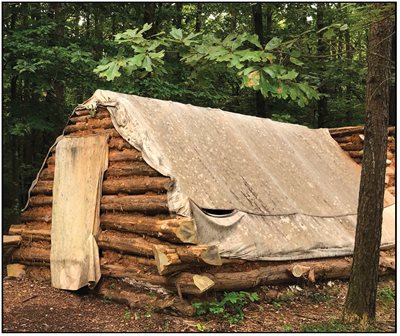 Fig. 1. Illnesses in camps, such as this one in Stafford County, Virginia, claimed more lives than battlefield wounds during the Civil War. Photo courtesy of the author.
Long stretches of inactivity were interrupted by strenuous marches of up to 25 miles per day in heavy wool uniforms on uneven roads with inadequate (or no) footwear.
The magnitude of death witnessed by Civil War soldiers was nearly unimaginable to previous generations, including generals who had served as privates or junior officers in the War of 1812 and the Mexican War. When they engaged opposing armies, “soldiers were choked or blinded by smoke, the roar of their own muskets deadened their eardrums, and they were pelted with clods of earth, pieces of metal, and sometimes human remains.”
4
In 12 hours of combat on the Antietam battlefield on September 17, 1862, 3,650 soldiers died from wounds. In comparison, the total number of soldiers killed in battle during the entire eight years of the Revolutionary War numbered around 8,600.
8 This vast increase in killing resulted from the increased accuracy of rifled firearms accompanied by little evolution in Napoleonic assault tactics, as tightly packed lines of men charged into open fields against entrenched defenders.
Until the Union Army of the Potomac’s Overland Campaign in the spring and summer of 1864, opposing armies generally took months after major battles to disengage, resupply, reorganize, and recuperate. From the first Battle of Bull Run (Manassas) to Gettysburg, intervals between major battles in the Eastern Theater ranged from 60 to 361 days, except for the three-week interval between the second Battle of Bull Run and Antietam. That changed with the Battle of the Wilderness (May 5-7, 1864), which initiated 40 days of virtually continuous fighting and marching between the Army of the Potomac and the Army of Northern Virginia and produced a staggering 55,000 Union and 33,000 Confederate soldiers dead, wounded, or missing.
9
A modern-day historical marker at the site of the Battle of Spotsylvania (see Fig. 2) recorded this description of the seemingly endless fighting:
For 22 hours combat raged on the landscape in front of you. Although the fighting extended for half a mile, the battle focused on a slight bend in the Confederate lines known thereafter as the Bloody Angle. The fighting here consisted of sustained, close-range rifle fire punctuated by Union attempts to storm the Confederate works.
... Bodies piled up in the rain-filled trenches, the living sometimes buried beneath the dead. After the battle, men were found torn by dozens of bullets. One man had 11 bullets through the soles of his feet alone. Another was so mutilated that friends could identify him only by the unusual color of his beard. It was carnage on an unimaginable scale.
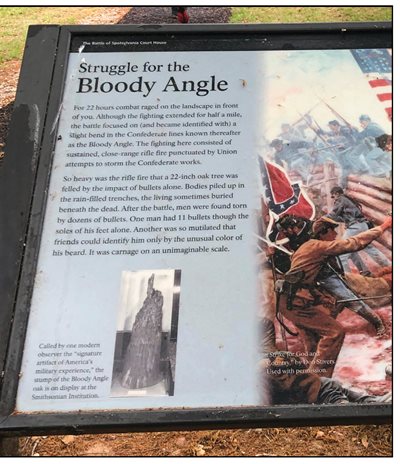 Fig. 2. Modern-day historical marker at the site of the Battle of Spotsylvania, Virginia. Photo courtesy of the author.
EFFECTS OF WAR TRAUMA ON MENTAL HEALTH
Fig. 2. Modern-day historical marker at the site of the Battle of Spotsylvania, Virginia. Photo courtesy of the author.
EFFECTS OF WAR TRAUMA ON MENTAL HEALTH
Soldiers and physicians of the era used several terms that presaged PTSD. To be “played out” referred to exhaustion and loss of stamina leading to emotional breakdown. “Nostalgia” consisted of severe despair and homesickness leading to listlessness, emaciation, and sometimes death.
10 Rather than medical issues, these were considered morale problems, for which prescribed treatments to restore the will to fight included drilling, shaming, and sending men back to the front lines.
5
Coping mechanisms for soldiers exposed to trauma included engaging their religious faith, lagging behind on marches and avoiding duties, employing camaraderie, and encouraging letter-writing.
4 Many soldiers became emotionally desensitized or indulged in gallows humor. Alcohol use, though underestimated in official statistics, was also a common coping strategy.
11 Of note, although the annual suicide rate among active-duty Union soldiers rose gradually over the course of the war from 8.7 to 14.5 per 100,000, it doubled in 1866 to 30.4 per 100,000 after most of the volunteer army had been demobilized.
11
Between 1865 and 1880, around 2,000 Union soldiers or veterans who suffered from mental illness were transferred from field or general hospitals (see Figs. 3 and 4) to the 250-bed St. Elizabeth’s Hospital in Washington, DC (then called the Government Hospital for the Insane).
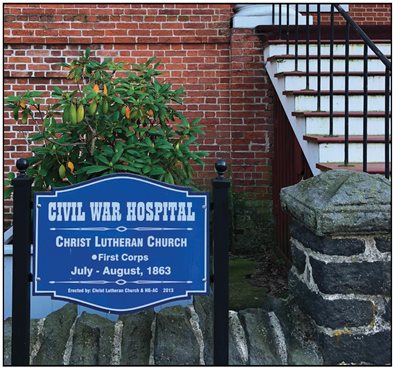 Fig. 3. The Civil War Hospital in Gettysburg was a field hospital established soon after the Battle of Gettysburg to treat casualties from that conflict. Photo courtesy of the author.
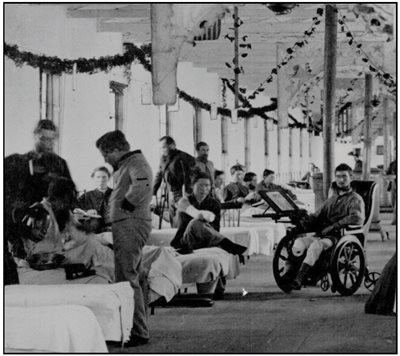
Fig. 4. Ward of the Carver National Hospital in Washington, DC, which was used as a general hospital where men were brought for lengthy recuperation from points far away. Photo from the National Archives and Records Administration.
Many admitted patients developed emotional problems or psychosis a decade or more after being discharged from the army.
4 At St. Elizabeth’s, the standard therapeutic regimen included rest, light labor in the hospital gardens, and the administration of opiates, stimulants, and “tonics” containing ingredients such as milk, eggs, sugar, and whiskey.
12
A 2006 study compared the military records of 17,700 Civil War veterans with postwar physical examinations conducted by the U.S. Pension Board surgeons and found that higher percentages of one’s company killed in action were associated with higher risks of comorbid nervous (neurologic or mental health) and cardiac or gastrointestinal diseases (risk ratio = 1.51). Compared to men who enlisted at age 30 or older, soldiers younger than age 18 had nearly twice the incidence of subsequent nervous and cardiac or gastrointestinal diseases.
13
PROGRESS TO THE PRESENT DAY
Over the next century, subsequent major conflicts — the Spanish-American War, World Wars I and II, Korea, and Vietnam — led to a better medical understanding of PTSD and refinement of strategies to prevent and treat “psychiatric casualties.”
14 The DSM-V diagnostic criteria for PTSD require a traumatic exposure and at least one of the following for more than one month: intrusive symptoms (e.g., flashbacks), avoidance, altered mood, or altered reactivity (e.g., hypervigilance or a tendency to have a startle response).
Today, PTSD has an estimated lifetime prevalence of 6% in the U.S. general population and up to 30% in Vietnam war veterans.
15 Several types of psychotherapy and antidepressants have been shown to reduce PTSD symptoms,
16 and a recent study of 840,000 veterans who received an initial PTSD diagnosis between 2016 and 2019 found that those who received cognitive processing or prolonged exposure therapy were 23% less likely to die by suicide than those who did not receive therapy.
17
An estimated 44,000 veterans currently reside in Lancaster and Lebanon counties. In 2024, they collectively made 24,000 visits to Penn Medicine Lancaster General Health practices, 500 of them (2%) for behavioral health reasons. We know that 7% of veterans self-identify as having PTSD, including 6% of men and 13% of women. Reflecting an overall pattern in the U.S. armed forces, they are at greatest suicide risk around the time of transition from military to civilian life.
18,19
CONCLUSION
At the conclusion of the U.S. Civil War, 160 years ago, millions of former Union and Confederate soldiers returned home, often permanently changed both physically and mentally by their experiences. Many of them, Sommerville observed, carried “a burden too heavy to bear”:
[Civil War] losses in dead, wounded and treasure have been well-documented; individual suffering, less so. And while suicides occurred among Union soldiers, there is evidence to suggest suicides occurred more frequently in the South during the war and following the defeat and collapse of the Confederacy, as broken soldiers returned home burdened with combat stress as well as the herculean task of rebuilding themselves, their families, and the region.
20
My fascination with Civil War history began when I visited Appomattox Court House National Historical Park in the fall of 2002, during my second year of Family Medicine residency at Lancaster General Hospital. During my fellowship at Georgetown University School of Medicine, I created and taught a medical student elective that traces the evolution of military medicine from the Civil War to the present day.
Caring for patients with PTSD in Washington, DC and Lancaster inspired me to learn more about the invisible wounds of those who served. Although weaponry and medical capabilities have advanced dramatically since the Civil War, the effects of trauma on the human psyche are universal.
ACKNOWLEDGEMENTS
This article is based in part on a webinar presented for the Lancaster Medical Heritage Museum in May 2024. The author thanks Adam Zurn from Uncharted Lancaster for sharing biographical information about John Mead, and Mark Simmons, MD, for providing context and data on mental health services for veterans in the greater Lancaster area.
RESOURCES FOR MILITARY PATIENTS AND EMPLOYEES
Penn Medicine is committed to supporting patients and employees who have served or continue to serve in the U.S. military.
Click here to learn more about the Veterans Care Excellence Program for military patients and employees.
Click here to log in to the Penn Cobalt Veteran Resource Center for LG Health employees.
REFERENCES
1. ‘Colonel’ John Mead, Enigmatic ‘Gentleman Bum’ of the River Hills, Lost House Rock Home Found! Uncharted Lancaster. Accessed January 2, 2025.
https://unchartedlancaster.com/colonel-john-mead-enigmatic-gentleman-bum-of-the-river-hills-lost-house-rock-home-found/
2. Pols H, Oak S. War & military mental health: the US psychiatric response in the 20th century.
Am J Public Health. 2007;97(12):2132-2142.
3. Lande RG. American Civil War medical practice, the post-bellum opium crisis and modern comparisons.
Hist Psychiatry. 2020;31(4):483-494.
4. Carroll DJ.
Invisible Wounds: Mental Illness and Civil War Soldiers. Louisiana State University Press; 2021.
5. Sommerville DM. Post traumatic stress disorder and the American Civil War. National Museum of Civil War Medicine. May 2, 2019. Accessed January 2, 2025.
https://www.civilwarmed.org/ptsd/
6. Leupo K. The history of mental illness. Girls Lost in the World. April 4, 2016. Accessed January 2, 2025.
https://www.kimberlyleupo.com/2016/04/athens-ohio-asylum-for-insane-flashback.html
7. Devine S.
Learning from the Wounded: The Civil War and the Rise of American Medical Science. The University of North Carolina Press; 2014.
8. Kiger PJ. How many died in the Revolutionary War? History.com. Updated January 29, 2025. Accessed April 4, 2025.
https://www.history.com/articles/revolutionary-war-deaths
9. Mackowski C.
Hell Itself: The Battle of the Wilderness, May 5-7, 1864. Savas Beatie; 2016.
10. Horwitz T. Did Civil War soldiers have PTSD? Smithsonian Magazine, January 2015. Accessed April 4, 2025.
https://www.smithsonianmag.com/history/ptsd-civil-wars-hidden-legacy-180953652/
11. Frueh BC, Smith JA. Suicide, alcoholism, and psychiatric illness among Union forces during the U.S. Civil War.
J Anxiety Disord. 2012; 26(7):769-775.
12. St. Elizabeth’s Hospital in the Civil War. National Museum of Civil War Medicine. November 25, 2020. Accessed January 2, 2025.
https://www.civilwarmed.org/st-elizabeths-hospital/
13. Pizarro J, Silver RC, Prause J. Physical and mental health costs of traumatic war experiences among Civil War veterans.
Arch Gen Psych. 2006;63(2):193-200.
14. Levin A. With changing insights, military psychiatry evolved over time.
Psychiatric News. 2019;54(22).
https://doi.org/10.1176/appi.pn.2019.5a27
15. Sartor Z, Kelley L, Laschober R. Posttraumatic stress disorder: evaluation and treatment.
Am Fam Physician. 2023;107(3):273-281.
16. Saguil A. Psychological and pharmacologic treatments for adults with PTSD.
Am Fam Physician. 2019;99(9):577-583.
17. Salunier KG, Brabbs S, Szymanski BR, et al. Suicide risk among veterans who receive evidence-based therapy for posttraumatic stress disorder.
JAMA Network Open. 2024;7(12):e2452144.
18. Simmons, Mark. Personal communication, December 6, 2024.
19. Borowski S, Caine ED, Kumar SA, Karras E, Gamble S, Vogt D. Well-being and suicidal ideation in U.S. veterans: age cohort effects during military-to-civilian transition.
Am J Prev Med. 2025;68(5):944-953.
20. Sommerville DM. A burden too heavy to bear. The New York Times. April 2, 2012. Accessed October 2, 2025.
http://opinionator.blogs.nytimes.com/2012/04/02/a-burden-too-heavy-to-bear/
Click here for a list of mental health resources available to clinicians and patients.