Winter 2025 - Vol. 20, No. 4
SCIENTIFIC REPORT
Street Medicine
Advancing Care for People Experiencing Homelessness in Lancaster

Nissley Cruz
Jared A. Nissley, MD, AAHIVS
Medical Director
Penn Medicine Lancaster General Health Street Medicine
Bianca Cruz, DNP, CRNP
Nurse Practitioner
Penn Medicine Lancaster General Health Street Medicine
The U.S. Department of Housing and Urban Development collects national data on homelessness through the annual Point-in-Time (PIT) Count, conducted each January to standardize reporting and guide federal funding. While it remains the best available data source, the PIT Count is widely viewed as an undercount of the true problem, as it does not count individuals living in hotels or who are “doubled up.” Nevertheless, the 2024 PIT Count recorded 771,480 Americans and 14,088 Pennsylvanians experiencing homelessness, reflecting steady increases since 2016 and sharp rises since 2022.
1
Similar trends have also been observed in Lancaster County since the PIT Count began in 2009 (see Fig. 1). Lancaster County’s 2025 PIT Count identified 546 individuals, including 64 unsheltered, a slight decrease from 2024 (597) but significantly higher than the nadir of 321 in 2017.
2
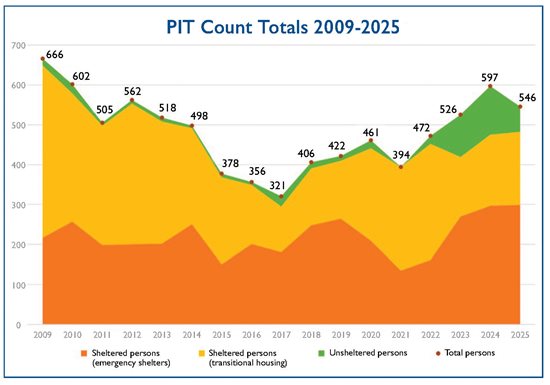 Fig. 1. HUD-reported PIT Count totals, Lancaster County. Adapted from Lancaster County Homelessness Coalition.
As homelessness has become more common and more visible, the topic has received increased attention in the popular press and from politicians, with leaders facing increasing pressure to take effective action to lessen the impact of homelessness on communities. People experiencing homelessness (PEH) are commonly portrayed as a plague on a community, bringing problems of crime and illicit drug use.
Unfortunately, only rarely does the conversation center on reducing the suffering experienced by our neighbors enduring the hardship. Not only are PEH at elevated risk for injuries, overdose, and exposure to the elements, but they are also more likely to experience adverse outcomes from chronic conditions like cardiovascular disease and cancer.
The most striking research reveals stark disparities in mortality data. A 2018
Lancet meta-analysis of “inclusion health populations,” defined as those experiencing social exclusion through homelessness, incarceration, sex work, or illicit substance use, found mortality rates 8 times higher for women and 12 times higher for men compared to the general population.
3
Similarly, a study in
JAMA reported elevated mortality rates among patients served by Boston Healthcare for the Homeless, with younger adults (25-44) dying at 9 times — and middle-aged adults (45-64) at 4.5 times — the Massachusetts average.
4
Meanwhile, traditional health care has consistently proved inadequate for the needs of people experiencing homelessness. PEH use acute health care services at rates well above the general population, with studies repeatedly showing high rates of emergency department visits, hospital admissions, and readmissions.
5,6 This is a pattern of health care utilization associated with high cost, yet it has not delivered equity in health outcomes. Worse yet, PEH frequently cite experiences of stigmatization in health care settings and consistently tie those experiences to care avoidance.
7
Over the past few decades, street medicine has emerged as a medical discipline aiming to address the gap between our suffering neighbors and a health care system that can often feel exclusive. Pioneers in the field include Boston Healthcare for the Homeless and Pittsburgh’s Operation SafetyNet, but the movement has grown to include hundreds of organizations across the United States.
Central to effective street medicine is a posture of radical inclusion demonstrated by a willingness to engage clients at any point in their journey toward health. Street medicine focuses on delivering care to clients in their lived environment — including parks, streets, and encampments — to eliminate as many barriers to medical care as possible. Practitioners recognize that survival on the streets frequently requires choosing between competing priorities like finding food or shelter, avoiding violence, or coping with mental illness or addiction.
Behaviors that seem self-destructive from the viewpoint of providers may be adaptive from the perspective of patients. As an example, PEH commonly use methamphetamine to maintain wakefulness to reduce the risk of violence. A welcoming and nonjudgmental approach is critical to gaining an understanding of the lived reality that shapes our patients’ lives and to developing the trust that allows for engagement over time.
While the needs of each community are varied, street medicine practitioners have coalesced around a uniting set of core values (see Table 1).
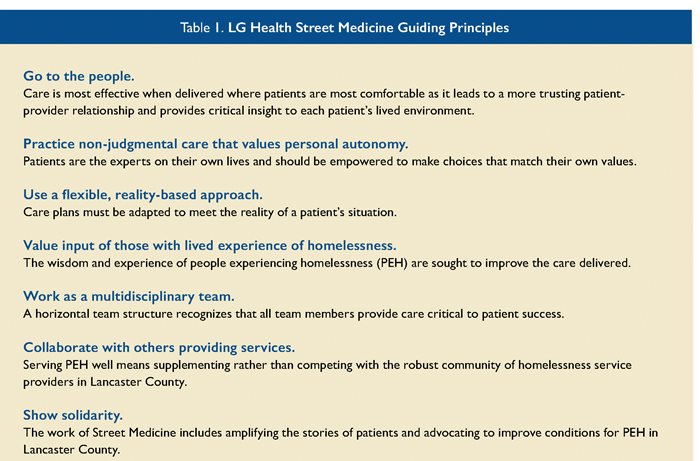 Borrowed heavily from the Street Medicine Institute8 and Venice Family Clinic Street Medicine.9
These values emphasize a deliberate effort to address the trauma and depersonalization that PEH frequently experience, with special attention to centering the patient as the foremost expert on their own lived reality and needs. This approach signifies respect for patient autonomy, recognizing each person’s right to make decisions about their health and circumstances.
Street medicine teams have frequently developed outside of academic institutions, and as a result, research has often taken a backseat to the urgency of clinical care. Still, some work has been done to assess the efficacy of medical care provided via the street medicine model.
A 2024 review highlighted the benefits of street medicine programs in the United States. Common features of programs are preventive services, chronic disease management, addiction treatment, vaccinations, insurance enrollment, and housing support. The review found that street medicine programs have the potential to substantially reduce emergency department visits and hospitalizations, with one model estimating potential health care cost savings of up to $9,000 per patient annually.
10
Street medicine began in Lancaster in 2021 when LGH Family Medicine resident physicians identified an unmet need and began making after-hours “street runs” modeled on programs in other cities. It quickly became clear that an effective program required a more consistent and coordinated response. Penn Medicine LG Health Street Medicine launched in its current form in the autumn of 2023 with a lean team of two clinicians (the authors). A year later, a nurse care manager joined the team.
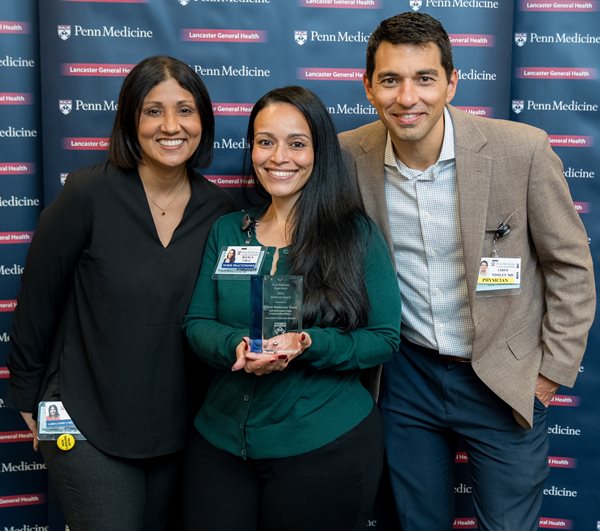 Members of the LG Health Street Medicine team include (L-R): Nurse Care Manager Kara Lewis, Nurse Practitioner Bianca Cruz, and Medical Director Dr. Jared Nissley. The photo was taken at the recent LG Health Advocacy Awards ceremony, where the team was recognized for their commitment to Penn Medicine Experience Standards.
The goal of LG Health Street Medicine is to take the services of a primary care practice to those who are experiencing homelessness wherever they might be — shelters, soup kitchens, parks, cars, encampments. In 2024, our care reached 466 distinct patients over 1,196 encounters, with hundreds more informal encounters. Many patients already have an established primary care relationship that we work to sustain. For others, we function as the primary connection to health care services.
We take a collaborative approach, working alongside outreach workers, social workers, and recovery specialists from agencies serving those experiencing homelessness, with the intention to augment rather than duplicate the services provided by other local agencies. Our patients are most concentrated in Lancaster City, but we also make regular visits to Elizabethtown, Columbia, and Ephrata.
We visit other locations across the county on an as-needed basis. We regularly see patients at the Clay Street Shelter and have a strong working relationship with health care services at Water Street Mission, although we do not typically see patients there.
We work out of backpacks and our cars, carrying a supply of basic medical equipment, along with survival items like water, socks, and blankets. Our most frequently encountered concerns are acute issues like respiratory, musculoskeletal, or skin complaints, but we frequently treat chronic diseases such as diabetes, hypertension, mental illness, or substance abuse. We have found it especially effective to dispense medications directly from our medication supply or to use grant and gift funds to cover patient co-pays at the LGH Convenience Pharmacy.
The streets and the lived reality of our patients are ever changing — thus our practice has frequently adapted to meet our patients’ needs over the past two years. We regularly reassess the best places to encounter our patients and the key community partners with whom our patients feel most welcome. One key change to date was the addition of an ambulatory care manager dedicated to addressing our patients’ needs for housing and social resource navigation.
With demand for our services outstripping our available time, we have shifted toward prioritizing serving individuals with chronic illness or disability that might put a patient at higher risk. As part of this strategy, we regularly make introductions to patients hospitalized at LGH to facilitate ongoing care after discharge. Of our encounters in 2024, 192 occurred within 30 days of an Emergency Department or hospital stay, reflecting the priority this takes in our work. Kelvin’s Story below demonstrates how connecting to patients during acute health episodes can bear fruit months or years down the road.
We recently began seeing patients at a renovated clinical space at the Lancaster County Food Hub’s day center, with a similar arrangement at the planned Prince Street Homelessness Services Hub anticipated in late 2026. These critical access points provide a safe place for high-quality care in a setting where patients already feel comfortable. Meanwhile, regulatory changes in Medicare and Medicaid have allowed us to generate insurance revenue for the first time in 2025, helping to ensure our financial sustainability. With access to affordable housing at crisis levels, we expect demand for our team’s services to remain high in 2026.
REFERRALS
The LG Health Street Medicine team welcomes referrals for patients experiencing homelessness with medical needs across Lancaster County who are poorly connected to primary care. The team can be contacted by phone at 717-544-6800 or via email or Epic staff message.
KELVIN’S STORY
Kelvin is a 38-year-old native of Lancaster and a father of three girls. As a teenager, he struggled in school, experienced intense anxiety, and found his mind racing uncontrollably. Then as a young adult, he cycled through dozens of jobs and eventually turned to drugs. Numbing his physical and emotional pain took precedence over most everything else in life.
Years later, Kelvin would reflect that the symptoms of bipolar disorder had gotten out of control, but without a mental health diagnosis or treatment plan, he became trapped in a pattern of survival. While he found ways to get by, the consequences of his behaviors began to add up. He recalls spending thousands of dollars on alcohol in a period of just six months. By his mid-30s, he found himself cut off from his family and without a place to stay.
While living on the street, Kelvin first encountered the Penn Medicine Lancaster General Health Street Medicine team at Anchor Lancaster, an outreach at First United Methodist Church that provides breakfast, case management services, and a day center. Of Anchor, Kelvin says, “People come here from all over to get help, and my help started at that church.” He recalls encounters at Anchor as being among the first in which he felt seen as a person and not a problem. He began to receive medical advice and medications from our team, but he was most struck by simple gestures that communicated compassion like being offered a shower. It was humanizing courtesies like these that planted the seed for change in Kelvin even as he continued to struggle.
Over several months, we observed how homelessness set off a dramatic decline in Kelvin’s health, both physically and emotionally. Without stable housing, he struggled to maintain his basic hygiene. He was prescribed medication but did not stick with it because of the chaos of his circumstances. In those dark days, his family remained at a distance, believing he was not making enough effort to improve his situation, which deepened his sense of isolation.
Over the following months, Kelvin had multiple encounters with the Street Medicine team at Anchor, Lancaster County Food Hub, and on the street. He appreciated the acceptance he felt and the invitation he received to shape his medical plan at his own pace. Yet Kelvin repeatedly chose to put himself in circumstances where he was likely to return to substance abuse, and we worried he would be lost to incarceration or worse.
While hospitalized after surviving an overdose, Kelvin was again visited by the Street Medicine team and subsequently agreed to enter drug rehabilitation and secure a bed in a sober living residence. Citing his daughters as his primary motivation, that hospital stay would become a turning point for Kelvin. He began to see a traditional primary care doctor and a psychiatrist. He attributes proper diagnosis and treatment as factors in helping him achieve more stability. Later, with the help of the team’s care manager, Kelvin was able to successfully obtain Social Security Disability Income.
Today, he is focused on rebuilding his life and being a positive example for his daughters. Kelvin is determined to break the cycle of untreated mental illness in his family. He wants to share his story so his family can see how far he’s come. He states that with the help of the Street Medicine team, he was “brought out of the dirt” and appreciates the team for being with him at “ground zero.”
Note: The names and details of this story were used with permission of the patient. Appropriate disclosure authorization was obtained.
REFERENCES
1. 2024 Annual Homelessness Assessment Report to Congress Part 1: Point-In-Time Estimates of Homelessness. U.S. Department of Housing and Urban Development, Office of Policy Development and Research. Updated December 27, 2024. Accessed June 19, 2025.
https://www.huduser.gov/portal/publications/2024-ahar-part-1-pit-estimates-of-homelessness.html
2. Lancaster County’s 2025 homeless count reflects service capacity shifts and extreme weather. Press release. Lancaster County Housing and Redevelopment Authorities. April 29, 2025. Accessed June 19, 2025.
https://lchra.com/wp-content/uploads/2025/04/Press-Release-2025-PIT-Data-Release.pdf
3. Aldridge RW, Story A, Hwang SW, et al. Morbidity and mortality in homeless individuals, prisoners, sex workers, and individuals with substance use disorders in high-income countries: a systematic review and meta-analysis.
Lancet. 2018;391(10117):241-250.
4. Baggett TP, Hwang SW, O’Connell JJ, et al. Mortality among homeless adults in Boston: shifts in causes of death over a 15-year period.
JAMA Intern Med. 2013;173(3):189-195.
5. Fields JD, Assaf RD, Nguyen KH, et al. Health care access and use among adults experiencing homelessness.
JAMA Health Forum. 2025;6(5):e250820.
6. Saab D, Nisenbaum R, Dhalla I, Hwang SW. Hospital readmissions in a community-based sample of homeless adults: a matched-cohort study.
J Gen Intern Med. 2016;31(9):1011-1018.
7. Reilly J, Ho I, Williamson A. A systematic review of the effect of stigma on the health of people experiencing homelessness.
Health Soc Care Community. 2022;30(6):2128-2141.
8. Our Vision and Mission. Street Medicine Institute. Accessed October 14, 2025.
https://www.streetmedicine.org/our-vision-mission
9. VFC Street Medicine. Venice Family Clinic. 2025. Accessed October 22, 2025.
https://venicefamilyclinic.org/street-medicine/taking-social-medicine-to-the-unsheltered/venice-family-clinic-approach-to-street-medicine/mission-and-core-values-of-venice-family-clinic/
10. Kaufman RA, Mallick M, Louis JT, Williams M, Oriol N. The role of street medicine and mobile clinics for persons experiencing homelessness: a scoping review.
Int J Environ Res Public Health. 2024;21(6):760.