Summer 2026 - Vol. 21, No. 2
The National Institutes of Health defines frailty as an age-related increase in vulnerability due to worsened outcomes from everyday or acute stressors.
1 Low-energy mechanisms of trauma, classified as simple falls from a sitting or standing position, are more common in older adults. Physicians and hospitals should expect to see an increase in frail, geriatric trauma patients. It is important to characterize frailty early, as it will affect how a patient is treated.
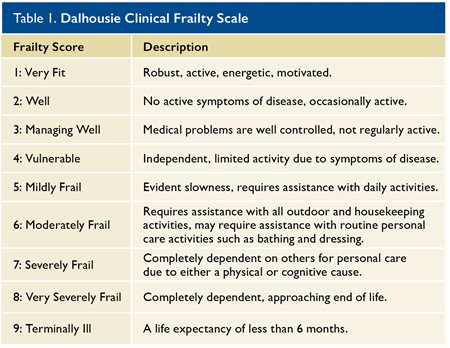
The Trauma Service at Penn Medicine Lancaster General Health works closely with the Geriatric Medicine Service when caring for trauma patients aged 65 years and older. Our clinicians began implementing the Clinical Frailty Scale (CFS) in 2019 to better assess the needs of geriatric trauma patients. The CFS measures frailty on a scale from one to nine (see Table 1).
2
Our research team in the Trauma and Acute Care Surgery Department conducted three retrospective studies on the effects of frailty, each utilizing the CFS looking at pelvic fractures, delirium, and rib fractures. Each study was approved by our organization’s Institutional Review Board, and none received funding. Data were provided by the trauma registry and stored in a database management system to ensure the protection of all patient health information.
FRAILTY AND GERIATRIC PELVIC FRACTURES
Our first frailty study, “Frailty Is Associated with Worse Outcomes in Geriatric Pelvic Fractures,”
3 conducted in 2022, examined outcomes of frail, geriatric trauma patients with pelvic frailty fractures, defined by the World Health Organization as “a fracture that is caused by an injury that would be insufficient to fracture normal bone.” In the pelvis, these can occur as a result of low-energy trauma such as a ground-level fall
4 and are likely to increase as the population ages.
Geriatric patients are at an increased risk of frailty fractures.
4 Frail, geriatric patients sustaining pelvic fractures may have complications that their younger counterparts do not due to decreased bone density in the pelvis. Many pelvic fractures can be treated nonoperatively if recovery and symptoms are closely monitored. There is limited research on frailty in geriatric patients and, more specifically, on frail patients with pelvic fractures. Therefore, we sought to determine if there was an association between frail, geriatric patients with pelvic fractures and worsened outcomes.
Our study included all geriatric patients who were aged 65 years and older presenting to our Level I Trauma Center between January 1, 2019, and September 30, 2021, who sustained a pelvic fracture and had a documented frailty score. Geriatricians at our institution utilize the Dalhousie Clinical Frailty Scale to assign patients a rating where 1 indicates a patient who is very fit and 9 indicates terminal illness.
Frailty scores are assigned based on a patient’s pre-injury characteristics (see Table 1).
2 For this study, patients were stratified into two groups: frail (CFS score >4) and non-frail (CFS score ≤4). Seventy patients met criteria to be included in this study. Of these 70 patients, 59% (n = 41) were frail and 41% (n = 29) were non-frail. All patients sustained a blunt mechanism of injury.
3
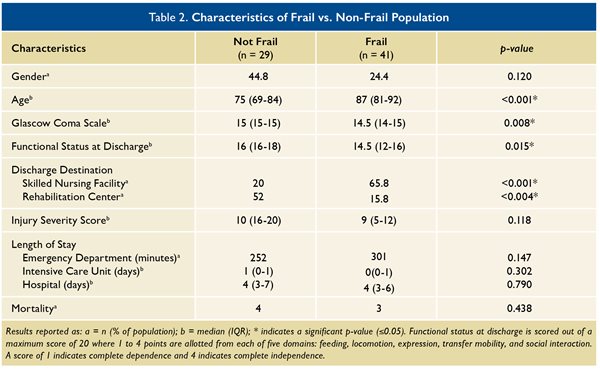
As shown in Table 2, frail patients in this study were found to be older than their non-frail counterparts, and Glasgow Coma Scale was found to be lower in the frail group as was functional status at discharge. Frail patients were more likely to be discharged to a skilled nursing facility and less likely to be discharged to an acute rehabilitation center. We found no difference between frail and non-frail patients regarding their Injury Severity Score, emergency department (ED) length of stay, intensive care unit (ICU) length of stay, or hospital length of stay. Additionally, we found no difference in mortality between frail and non-frail patients.
3
Although there was no difference in mortality between frail patients and non-frail patients who sustained pelvic fractures, frail patients had an overall worse outcome than their non-frail counterparts. Frail patients, on average, had a lower functional status at discharge, and nearly two-thirds of the sample were discharged to a skilled nursing facility.
Earlier studies have demonstrated a higher frailty score correlates with increased risk of mortality,
5 yet we did not find an increase in mortality; this could be due to our smaller sample size and stratification of patients into frail and non-frail categories. Further consideration and investigation are necessary to identify potential means to mitigate the increased risk of morbidity in this patient population.
DELIRIUM AND GERIATRIC TRAUMA
The second study, “There’s No Place Like Home: Delirium as a Barrier in Geriatric Trauma,”
6 conducted in 2024, focused on the effect of delirium in geriatric trauma patients. Delirium, a state of being in which a patient is confused for a period of time, is common among geriatric patients.
7 Although typically a temporary state of being, it can have a prolonged course with lasting effects. Delirium is also more common among those hospitalized for severe illnesses and requiring a higher level of care.
Many factors can increase the risk of delirium including infection, dementia, malnutrition, and admission to the ICU.
6-9 Delirium is commonly under-diagnosed and, if initially overlooked, can be more costly and often fatal.
7 Delirium can lead to longer hospital length of stay, increased hospital costs, and greater risk of in-hospital mortality.
7 Therefore, we conducted this study to understand the modifiable and non-modifiable factors associated with the development of delirium in the geriatric trauma population.
This retrospective chart review study included all geriatric trauma patients who were admitted to our Level I Trauma Center with a documented frailty score from January 1, 2019, to September 30, 2021. Frailty scores were assigned by a geriatrics provider utilizing the CFS outlined in Table 1.
6 Patients were stratified into two groups: delirium (D) and without delirium (ND). A diagnosis of delirium was confirmed by a geriatrician.
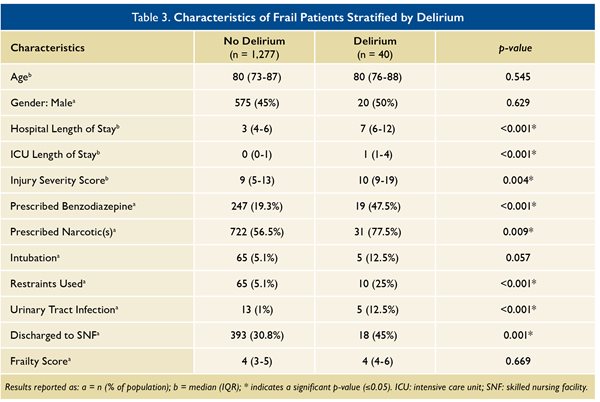
As shown in Table 3, 1,317 patients met inclusion criteria of this study for having a documented frailty score and being aged 65 years and older. Of these, 3.04% of patients (n = 40) were found to have delirium.
6 There was no significant difference in age or gender between patients with delirium and patients without delirium, however patients with delirium stayed in the hospital for a median length of seven days, while the median length of stay for those who did not have delirium was three days. Those with delirium stayed in the ICU one day, while those without delirium stayed zero days. The Injury Severity Score was found to be higher in those with delirium than those without (10 versus 9).
Additionally, those who experienced delirium as opposed to those who did not experience delirium were more likely to have had a benzodiazepine prescribed preadmission (47.5% versus 19.3%) and to have had a narcotic prescribed preadmission (77.5% versus 56.5%).
Patients who experienced delirium as opposed to those without delirium were more likely to be intubated (12.5% versus 5.1%), to be placed in restraints (25% versus 5.1%), to have a urinary tract infection (12.5% versus 1%), and to be discharged to a skilled nursing facility (45% versus 30.8%). When comparing frailty scores for the delirium group versus no delirium group, there was no significant difference in median frailty score.
6
Women had longer stays in both the hospital (8 days, interquartile range [IQR] = 6.5-14.5, versus men: 6 days, IQR = 4.5-8, p = 0.022) and in the ICU (3.5 days, IQR = 1-5, versus men: 1 day, IQR = 0-3, p = 0.016). Furthermore, women were more likely than men to have a urinary tract infection (20.0% of women versus 5% of men, p = 0.049) and to be discharged to a skilled nursing facility (50% of women versus 40% of men, p = 0.007).
6
Upon multivariable logistic regression to assess risk of delirium, we found an increase in hospital length of stay (adjusted odds ratio (AOR): 1.08, p = 0.016), positive urine drug screen (AOR: 2.587, p = 0.041), and documented urinary tract infection (AOR: 5.206, p = 0.018) were significant risk factors for developing delirium.
Surprisingly, delirium and frailty were not directly correlated in our study. What we found instead was that geriatric patients with delirium were more likely to be female and discharged to a skilled nursing facility.
7
This reaffirms our hypothesis that delirium and frailty must both be considered when caring for a geriatric trauma patient and further highlights results from our pelvic fracture study, which found that frail patients were more likely female and more likely to be discharged to a skilled nursing facility.
FRAILTY AND GERIATRIC RIB FRACTURES
For our third study, “Rib Fractures and Frailty in Geriatric Trauma Patients,”
10 also conducted in 2024, we examined the outcomes associated with frail, geriatric patients who present with rib fractures. In this retrospective chart review study, we included all geriatric patients (aged 65 years and older) with a documented frailty score and two or more rib fractures. Patients were stratified into multiple groups, including frail versus non-frail cohorts, and stratified based on number of rib fractures (≤3 versus >3).
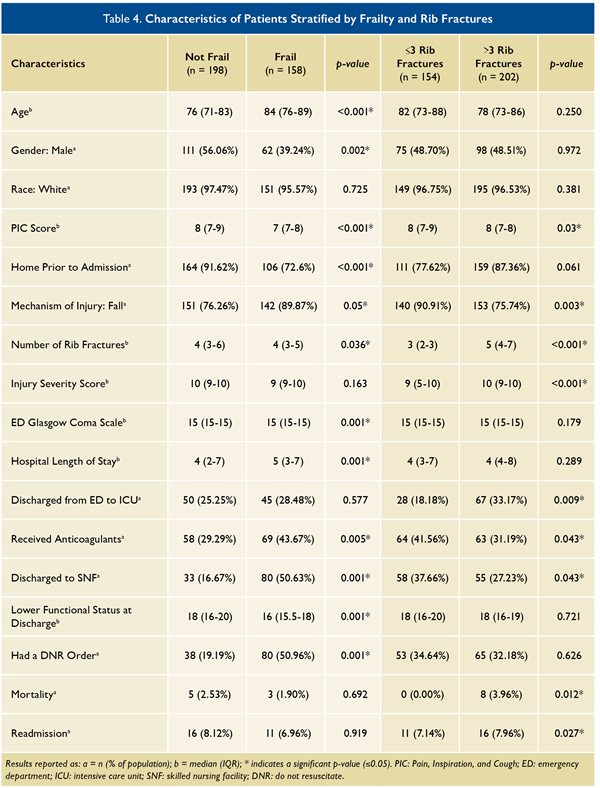
As shown in Table 4, a total of 356 patients met inclusion criteria; of these, 44.38% of patients (n = 158) were frail. When stratified by the number of rib fractures, we found 56.75% of the 356 patients had >3 rib fractures. Frail patients were more likely to be female (60.76% versus 43.94%, p = 0.002) and older: median age of frail patients was 84 years; median age of non-frail patients was 76 years.
Frail patients, as opposed to non-frail patients, were less likely to live at home before their injury (72.6% versus 91.62%), were more likely to be discharged to a skilled nursing facility (50.63% versus 16.67%), and were more likely to have been receiving anticoagulants (43.67% versus 29.29%). Frail patients were also more likely to have had a fall as the mechanism of injury (89.87% versus 76.26%).
As in our first study, we found that frail patients, as opposed to non-frail patients, were more likely to have a lower functional status at discharge than their non-frail counterparts (16 versus 18). It is important to note that a lower functional status at discharge likely correlates with poorer outcomes.
Pain, Inspiration, and Cough (PIC) scores range from 3-10 and help describe the severity of symptoms in patients with rib fractures; lower scores correlate with more severe presentation. In our study, patients who were frail, as opposed to those who were not frail, were more likely to have lower — or more concerning — PIC scores (7 versus 8). Additionally, patients with >3 rib fractures, as opposed those with ≤3 rib fractures, were more likely to be admitted to the ICU from the ED (33.17% versus 18.18%).
10 Additional results of this study are further outlined in Table 4.
CONCLUSION
Given the relative lack of studies on frailty in the geriatric trauma population, additional research must be done to gain more conclusive results. One study idea from our research team aims to investigate the correlation between traumatic injuries and osteoporosis in frail, geriatric females.
Another study idea includes preemptive frailty screening on patients who use anticoagulants to determine if they have increased frailty risk.
10 The continued study of frailty factors can be important in the prevention and treatment of the aging U.S. population.
Frailty must be considered by clinicians when caring for a geriatric population. Because a state of frailty can be caused by many physiological factors, research on this topic is vital in providing a deeper understanding of how to identify and reduce frailty in geriatric populations. If health providers in the United States take the necessary steps to prevent progression of frailty, we may be able to decrease the risk for medical complications and help keep our elderly patients healthy.
REFERENCES
1. Xue QL. The frailty syndrome: definition and natural history.
Clin Geriatr Med. 2011;27(1):1-15.
2. Church S, Rogers E, Rockwood K, Theou O. A scoping review of the Clinical Frailty Scale.
BMC Geriatr. 2020;20(1):393.
3. Perea LL, Fort LS, Morgan ME, Brown CT, Wang S, Bradburn E. Frailty is associated with worse outcomes in geriatric pelvic fractures.
Am Surg. 2022;88(7):1573-1575.
4. Rommens PM, Wagner D, Hofmann A. Fragility fractures of the pelvis.
JBJS Rev. 2017;5(3):e3
5. Pecheva M, Phillips M, Hull P, et al. The impact of frailty in major trauma in older patients.
Injury. 2020;51(7):1536-1542.
6. Toure A, Tadi R, Meagher M, et al. There’s no place like home: delirium as a barrier in geriatric trauma.
J Surg Res. 2024;293:89-94.
7. Aldemir M, Ozen S, Kara IH, Sir A, Baç B. Predisposing factors for delirium in the surgical intensive care unit.
Crit Care. 2001;5(5):265-270.
8. Francis J. A prospective study of delirium in hospitalized elderly.
JAMA. 1990;263:1097e1101.
9. American Geriatrics Society Beers Criteria
® Update Expert Panel. American Geriatrics Society 2019 updated AGS Beers Criteria
® for potentially inappropriate medication use in older adults.
J Am Geriatr Soc. 2019;67(4):674-694.
10. Brown JH, LaRosa SK, Moore KG, Perea LL. Rib fractures and frailty in geriatric trauma patients.
Am Surg. 2024;90(7):1971-1973.