Summer 2026 - Vol. 21, No. 2
Estimates of the global burden of diabetes exceed 530 million adults with type 2 diabetes mellitus (T2DM), accounting for more than 95% of total cases worldwide.
1,2 In Lancaster General Health Physicians (LGHP) practices, there are approximately 32,000 patients living with diabetes. Over the past two decades, novel agents for management of T2DM have come to market, and the guidelines for management of individuals with diabetes have changed significantly as a result.
3,4 Two novel classes of medications acting on the incretin pathway are dipeptidyl-peptidase-IV (DPP-4) inhibitors and glucagon-like peptide-1 receptor agonists (GLP-1 RAs).
DPP-4 inhibitors are oral agents that improve glycemic control via inhibition of the DPP-4 enzyme, which decreases the breakdown of GLP-1 and glucose-dependent insulinotropic polypeptide (GIP).
5 GLP-1 RAs, given orally or subcutaneously, directly activate the GLP-1 receptor to stimulate insulin secretion from the pancreatic beta cells.
5,6 Due to the overlapping pathway within the incretin system, concomitant use of DPP-4 inhibitors and GLP-1 RAs is considered a duplication of therapy.
3 When comparing simultaneous use of these agents versus monotherapy of either class alone, patients experience modest improvements in glycemic control and minimal additional weight loss.
7,8
In one study, sitagliptin was added to liraglutide therapy, and although GLP-1 and GIP concentrations increased, marginal, non-significant changes were seen in glycemic levels.
5 Another published case series of patients with T2DM taking once-weekly GLP-1 RAs and simultaneous DPP-4 inhibitors demonstrated a median change in glycosylated hemoglobin A1c (HgbA1c) of –0.8% (interquartile range [IQR] = –4.3% to 2%). In the analysis, 28% of patients experienced gastrointestinal adverse reactions and 17% experienced hypoglycemia symptoms.
7
As these two drug classes are more expensive compared to alternative non-insulin medications used to treat diabetes, the concomitant use of GLP-1 RAs and DPP-4 inhibitors can lead to excessive medication costs for both patients and the health care system.
5 For example, using the local zip code and price estimates from GoodRx, a four-week supply of brand dulaglutide costs $1,039 and 30 tablets of brand sitagliptin 100 mg cost $342, while a 30-day supply of extended-release metformin (at 2,000 mg/day) costs $8 and 30 tablets of glipizide ER 5 mg cost $9. Therefore, it is reasonable to review instances in which GLP-1 RAs and DPP-4 inhibitors are being used together with the intent of reducing the concomitant use of these drug classes.
Penn Medicine Lancaster General Health is a rural community health system located in Pennsylvania that serves Lancaster County as well as several surrounding counties. There are 15 ambulatory clinical pharmacists embedded within 12 of 28 LGHP Family Medicine practices; these pharmacists practice under collaborative drug therapy management (CDTM) agreements.
In the electronic health record (EHR), a duplicate therapy warning is triggered at the time of prescribing to discourage the concomitant use of GLP-1 RAs with DPP-4 inhibitors. Prescribers must acknowledge the interaction to bypass the alert in order to prescribe two agents from these drug classes at the same time. They are able to enter additional clarifying information regarding why they are prescribing both classes together; this warning is therefore not a hard stop (see Fig. 1).
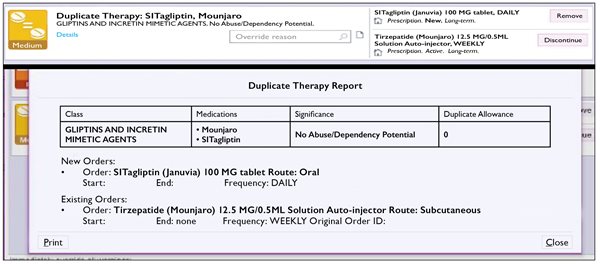 Fig. 1. Epic warning that fires when GLP-1 RAs and DPP-4 inhibitors are simultaneous active prescriptions.
METHODS
Fig. 1. Epic warning that fires when GLP-1 RAs and DPP-4 inhibitors are simultaneous active prescriptions.
METHODS
This single-center retrospective review was conducted across LGHP Family Medicine practices and was approved by the Lancaster General Hospital Institutional Review Board. An Epic SlicerDicer report was utilized to identify adult patients who had both a DPP-4 inhibitor and a GLP-1 RA or GLP-1/GIP dual agonist on their active medication list from January 1, 2023, to July 31, 2023.
Of the patients identified, the EHR dispense report was reviewed to determine if patients were actively filling both medications based on claim information from the dispensing pharmacy. Prescriber notes were reviewed to ensure appropriate inclusion of patients concomitantly prescribed and filling both agents.
Patients were included if they were over the age of 18 years and if the active prescriptions for the DPP-4 inhibitor and GLP-1 RA were both being filled simultaneously for at least one month. Combination products, such as those with a DPP-4 inhibitor plus metformin, were also included. Patients were excluded if they were seen by a primary care clinician outside of LGHP or if they were deceased.
Key data points collected include patient demographics and insurance type, primary care clinician and office location, whether the patient was seen by an ambulatory clinical pharmacist in the past year, the active medication list, time between initiation of first and second agent, outpatient pharmacy information, and pertinent glycosylated HgbA1c values.
Three HgbA1c values were reviewed. The first (HgbA1c #1) was obtained prior to initiation of the first agent; the second (HgbA1c #2) was obtained while on the first agent but prior to initiation of the second agent; the last (HgbA1c #3) was the most recent HgbA1c value obtained after initiation of the second agent. The minimum time between each HgbA1c was three months.
The primary outcome of this study was to determine the frequency of patients who were prescribed and filling both DPP-4 inhibitors and GLP-1 RAs. Secondary outcomes included the rate of occurrence at an outpatient practice with versus without an integrated CDTM ambulatory clinical pharmacist, impact of use pattern on HgbA1c, and adverse events potentially due to concomitant use of DPP-4 inhibitors and GLP-1 RAs. All outcomes were compared utilizing descriptive statistics (average, standard deviation).
At the conclusion of the study, ambulatory clinical pharmacists contacted the prescribers of these 28 individuals via the electronic health record and recommended discontinuation of the DPP-4 inhibitor.
RESULTS
From the initial report, 138 patients were identified to have both a DPP-4 inhibitor and GLP-1 RA on their active medication list in the specified timeframe. Baseline patient demographics and characteristics are listed in Table 1.
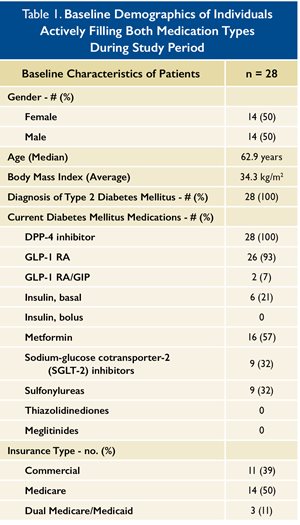
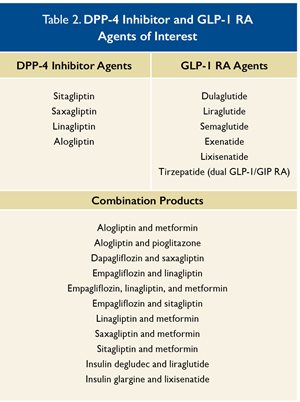
Of the 138 patients identified to have both a DPP-4 inhibitor and GLP-1 RA on their active medication list, 28 (20%) were found to be actively filling both agents. The DPP-4 inhibitors, GLP-1 RAs, and combination products that were revealed to be co-prescribed during the review are detailed in Table 2.
Sixteen (57%) of the 28 patients actively filling medications from both drug classes received care at a site without a CDTM ambulatory clinical pharmacist embedded within the practice. None of the patients were seen by an ambulatory clinical pharmacist or an endocrinologist within one year from the start of the enrollment period.
The majority of patients who had both drug classes on their active medication list were not actively filling both medications concomitantly but rather were transitioned from one drug class to the other. Notably, there was one patient identified to be actively filling and taking two DPP-4 inhibitors and one GLP-1 RA.
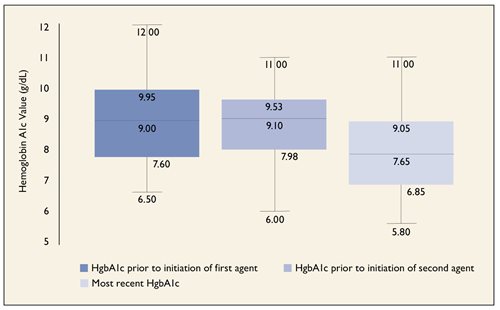 Fig. 2. Average glycosylated hemoglobin A1c (HgbA1c) at specified time points of individuals who were actively filling both medication types during the study.
As seen in Fig. 2, the median HgbA1c #1, HbgA1c #2, and HgbA1c #3 was 9.00% (IQR = 7.60-9.95), 9.10% (IQR = 7.98-9.53), and 7.65% (IQR = 6.85-9.05), respectively. The first agent prescribed in 25 out of 28 patient cases was a DPP-4 inhibitor. After the first agent was added, the median HgbA1c increased by 0.10%. After the initiation of the second agent, the median HgbA1c decreased by 1.45% to 7.65%.
The start of the first agent was recorded by either the first time the prescription was ordered or, if they were started on it outside of LGHP, the first time it was noted in the patient’s chart. There was a median of 25.5 months (IQR = 34.7) from the time the first agent was started to the addition of the second agent, and there was a wide range of 3 months to 93 months. The duration of overlap of both agents was collected, and there was a median of 20 months (IQR = 52.3) of patients taking a DPP-4 inhibitor and a GLP-1 RA concomitantly.
Adverse events possibly attributable to the concomitant therapy of both a DPP-4 inhibitor and a GLP-1 RA were discovered in one patient, who reported experiencing diarrhea during a follow-up visit per clinician documentation. There was no additional documentation by the primary care clinician regarding symptom onset, and no changes were made to the patient’s medication regimen. Based on this limited information, it is not possible to say if the patient’s diarrhea was due to either agent alone or the combination.
LIMITATIONS
This study had several limitations, including the retrospective nature of chart reviews within the EHR and the smaller sample size of patients included in the secondary evaluation. Reports of adverse effects were low, which could be due to a lack of documentation. In addition, regarding patients who were not started on therapy within this health system, the first HgbA1c value and the duration of therapy could only be collected based on first documentation of the agents in the chart. There was only one individual who did not have an accessible HgbA1c in the EHR prior to initiating the first medication.
Many patients in this review had been on both agents for several years. The decrease in some patients’ HgbA1c values could be due to lifestyle modifications or the initiation of other additional agents, including insulin, during this time, but this cannot be known for certain. It was also not known if the doses used for GLP-1 RAs were titrated appropriately. Knowing the doses of the medicines relative to the HgbA1c could have helped determine if the doses were titrated to target.
It is not known how many patients in these practices who had diabetes were strictly on treatment with one of these agents exclusive of the other class.
Despite these limitations, the data presented show a role for ambulatory clinical pharmacist intervention to improve the prescribing of these medication classes.
DISCUSSION
Despite 138 patients being identified with a DPP-4 inhibitor plus a GLP-1 RA on their medication list, only 20% of them were filling both medications. This demonstrates the need for improved medication reconciliation practices to increase medication list accuracy. Pharmacists can play a vital role in the medication reconciliation process. It is possible that some prescribers may leave both drug classes on the medication list to allow for prior authorizations or for the patient to determine if the new medication is cost feasible. However, in many patients there was no follow-up to remove one of the medications from the list.
The first agent prescribed in 25 out of 28 patients (89.3%) was a DPP-4 inhibitor. This could be due to the timeline of market approvals in the United States (the first DPP-4 inhibitor was approved in 2006, versus 2009 for the first GLP-1 RA) and that DPP-4 inhibitors are oral agents while most GLP-1 RAs are injectable. The first oral GLP-1 RA (oral semaglutide) did not become available until 2019.
The average HgbA1c #1 (prior to initiation of the first DPP-4 inhibitor or GLP-1 RA) was 8.84% (SD ±1.73%). After the first agent was added, the average HgbA1c increased by 0.1%. This change is minimal given that most patients started with an HgbA1C >8% and most patients have an Hgb-A1C goal of either <7% or <8%.
3
With the initiation of the second agent, which was typically the GLP-1 RA in this review, the average Hgb-A1c decreased to 7.86% (SD ±1.35%). While this is a reduction, it is not quite what would be expected by solely adding a GLP-1 RA to a patient’s regimen. Since the doses of prescribed medicines were not noted during the course of this study, it is possible that the reduction in HgbA1c would have been of greater magnitude if GLP-1 RAs had been titrated to the maximally tolerated doses.
Historically, GLP-1 RAs lower HgbA1C by >1%, and some studies have shown HgbA1C-lowering potential as much as 2%.
3,9-11 This raises questions as to whether therapies were uptitrated according to the approved product labeling and if patients were adherent to their medications. Nonetheless, our results are consistent with the known greater glycemic-lowering potential of GLP-1 RAs compared to DPP-4
inhibitors.
After the identification of patients actively filling both medications, ambulatory clinical pharmacists contacted the prescribers to recommend discontinuation of the DPP-4 inhibitors.
While the cost of DPP-4 inhibitors and GLP-1 RAs is historically similar, clinicians should consider the preferential health outcomes that are associated with GLP-1 RAs. Several GLP-1 RAs have demonstrated cardioprotective effects including reductions in major cardiovascular (CV) events such as non-fatal myocardial infarction, non-fatal stroke, and CV death.
3,9,11-15
Outcome trials of DPP-4 inhibitors have not demonstrated that these medicines lead to CV benefits, and while a potential increase in heart failure hospitalizations among individuals prescribed DPP-4 inhibitors has been shown, the data have not been consistent; current guidelines recommend DPP-4 inhibitors not be used in patients with heart failure.
16-19 GLP-1 RAs promote more weight loss compared to DPP-4 inhibitors; this may be another reason to prefer this drug class, given the prevalence of obesity in patients with T2DM.
3,9 Deprescribing either medication will also reduce medication use burden and medication costs to the patient.
Based on the results of this medication use evaluation, ambulatory clinical pharmacists made 28 recommendations to primary care clinicians regarding duplication of therapy which resulted in an acceptance rate of 78.5%. One of the 28 recommendations was acknowledged without any change made; the remaining five were declined. In the cases of declination, clinicians cited no adverse effects and patient preference as justification to continue. In all cases that were accepted, the DPP-4 inhibitor was the medication that was subsequently discontinued.
One case of interest involved a patient who was prescribed two DPP-4 inhibitors in addition to one GLP-1 RA. In this case, there were no notes in the patient’s chart from the clinician elucidating why the patient would be on this regimen.
The majority of the clinicians treating patients with both a DPP-4 inhibitor and a GLP-1 RA do not have an embedded clinical pharmacist in their practice. In our health system, clinical pharmacist involvement with diabetes management is dependent upon clinician referrals, and approximately half of the Family Medicine practices do not have a dedicated ambulatory clinical pharmacist. Due to the limited number of ambulatory clinical pharmacist full-time equivalents and competing priorities, many clinicians do not have access to or interact with pharmacist clinicians on a regular basis.
As described in this report, there is a role for ambulatory clinical pharmacists to promote evidence-based prescribing. It is well established that embedding pharmacists in primary care practices results in improved patient outcomes as well as decreased health care costs. One study identified a 1.75% decrease in HgbA1c for patients treated in a physician-pharmacist collaborative care group compared to an average 0.16% decrease in HgbA1C among patients treated in a usual care group without a pharmacist involved (p <0.05).
20
The ambulatory clinical pharmacists at LG Health who are embedded in Family Medicine practices manage diabetes for patients under a CDTM agreement. It is notable that no patients found to be taking drugs from both medication classes were seen by an ambulatory clinical pharmacist during the study period. With additional pharmacist resources, pharmacists would be able to provide medication management services to all Family Medicine practices and potentially reduce inappropriate prescribing.
Using available payor data, we calculated potential cost savings from recommended interventions for both LG Health and patients. The estimated cost to LG Health for the use of an unnecessary DPP-4 inhibitor over the course of a year is more than $5,000. From the data presented, if all interventions were accepted by the clinicians, then the health care system savings could exceed $180,000 per year. Some recommendations were accepted, and those pharmacist-initiated interventions resulted in an estimated cost savings of approximately $115,000 to the health care system per year and approximately $600 to each patient per year. Patient savings is valued based on an estimated monthly copay.
CONCLUSION
The results of this retrospective chart review demonstrate that despite guidelines and literature advising against concomitant use of GLP-1 RA and DPP-4 inhibitors, they are still prescribed together.
REFERENCES
1. Diabetes Statistics. National Institute of Diabetes and Digestive and Kidney Diseases. Published September 15, 2019. Accessed July 28, 2023.
https://www.niddk.nih.gov/health-information/health-statistics/diabetes-statistics
2. Magliano DJ, Boyko EJ; IDF Diabetes Atlas 10th edition scientific committee. IDF DIABETES ATLAS [Internet]. 10th ed. Brussels: International Diabetes Federation; 2021.
3. American Diabetes Association Professional Practice Committee for Diabetes. 9. Pharmacologic approaches to glycemic treatment: standards of care in diabetes-2026.
Diabetes Care. 2026;49(Supplement_1):S183-S215.
4. Samson SL, Vellanki P, Blonde L, et al. American Association of Clinical Endocrinology consensus statement: comprehensive type 2 diabetes management algorithm-2023 update.
Endocr Pract. 2023;29(5):305-340. Erratum in:
Endocr Pract. 2023;29(9):746. Erratum in:
Endocr Pract. 2023;29(12):1025.
5. Nauck M. Incretin therapies: highlighting common features and differences in the modes of action of glucagon-like peptide-1 receptor agonists and dipeptidyl peptidase-4 inhibitors.
Diabetes Obes Metab. 2016;18(3):203-216.
6. Razavi M, Wei YY, Rao XQ, Zhong JX. DPP-4 inhibitors and GLP-1 RAs: cardiovascular safety and benefits.
Mil Med Res. 2022;9(1):45.
7. Lajthia E, Bucheit JD, Nadpara PA, et al. Combination therapy with once-weekly glucagon like peptide-1 receptor agonists and dipeptidyl peptidase-4 inhibitors in type 2 diabetes: a case series.
Pharm Pract (Granada). 2019;17(4):1588.
8. Nauck MA, Kahle M, Baranov O, et al. Addition of a dipeptidyl peptidase-4 inhibitor, sitagliptin, to ongoing therapy with the glucagon-like peptide-1 receptor agonist liraglutide: a randomized controlled trial in patients with type 2 diabetes.
Diabetes Obes Metab. 2017;19(2):200-207.
9. Reid T. Choosing GLP-1 receptor agonists or DPP-4 inhibitors: weighing the clinical trial evidence.
Clin Diabetes. 2012;30(1):3-12.
10. Berg JK, Shenouda SK, Heilmann CR, Gray AL, Holcombe JH. Effects of exenatide twice daily versus sitagliptin on 24-h glucose, gluco-regulatory and hormonal measures: a randomized, double-blind, crossover study.
Diabetes Obes Metab. 2011;13(11):982-989.
11. Tsapas A, Averinos I, Karagiannis T, et al. Comparative effectiveness of glucose-lowering drugs for type 2 diabetes.
Ann Intern Med. 2020;173(4):278-286.
12. Violante R, Oliveira JH, Yoon KH, et al. A randomized non-inferiority study comparing the addition of exenatide twice daily to sitagliptin or switching from sitagliptin to exenatide twice daily in patients with type 2 diabetes experiencing inadequate glycaemic control on metformin and sitagliptin.
Diabet Med. 2012;29(11):e417-e424.
13. Van Gaal L, Souhami E, Zhou T, Aronson R. Efficacy and safety of the glucagon-like peptide-1 receptor agonist lixisenatide versus the dipeptidyl peptidase-4 inhibitor sitagliptin in young (<50 years) obese patients with type 2 diabetes mellitus.
J Clin Transl Endocrinol. 2014;1(2):31-37.
14. Marso SP, Daniels GH, Brown-Frandsen K, et al. Liraglutide and cardiovascular outcomes in type 2 diabetes.
N Engl J Med. 2016;375(4):311-322.
15. Blonde L, Klein EJ, Han J, et al. Interim analysis of the effects of exenatide treatment on A1C, weight and cardiovascular risk factors over 82 weeks in 314 overweight patients with type 2 diabetes.
Diabetes Obes Metab. 2006;8(4):436-447.
16. Singh AK, Singh R. Heart failure hospitalization with DPP-4 inhibitors: a systematic review and meta-analysis of randomized controlled trials.
Indian J Endocrinol Metab. 2019;23(1):128-133.
17. Scirica BM, Bhatt DL, Braunwald E, et al. Saxagliptin and cardiovascular outcomes in patients with type 2 diabetes mellitus.
N Engl J Med. 2013;369(14):1317-1326.
18. Zannad F, Cannon CP, Cushman WC, et al. Heart failure and mortality outcomes in patients with type 2 diabetes taking alogliptin versus placebo in EXAMINE: a multicentre, randomised, double-blind trial.
Lancet. 2015;385(14):2067-2076.
19. Dunlay SM, Givertz MM, Aguilar D, et al. Type 2 diabetes mellitus and heart failure: a scientific statement from the American Heart Association and the Heart Failure Society of America: this statement does not represent an update of the 2017 ACC/AHA/HFSA heart failure guideline update.
Circulation. 2019;140(7):e294-e324.
20. Norton MC, Haftman ME, Buzzard LN. Impact of physician-pharmacist collaboration on diabetes outcomes and health care use.
J Am Board Fam Med. 2020;33(5):745-753.