Summer 2026 - Vol. 21, No. 2
SCIENTIFIC REPORT
Relative Energy Deficiency in Sport
Pan Laessig DiPaolo Dreher
Kevin Pan, DO, MEd, PGY-4, Sports Medicine Fellow
Minuette Laessig, MD, PGY-2, Family Medicine Resident
Laura DiPaolo, MD, CAQSM, Associate Program Director, Primary Care Sports Medicine
Geoffrey Dreher, DO, CAQSM, FAOASM, Program Director, Primary Care Sports Medicine
Penn Medicine Lancaster General Health
In 2014, the International Olympic Committee (IOC) coined the term “Relative Energy Deficiency in Sport” (REDs) and defined it as a disorder of low energy availability with characteristic symptoms that impact males and females.
1 They updated their statement in 2023 to further explain the impact of REDs.
2
The underlying cause for REDs is a mismatch between energy used and energy consumed, leading to low energy availability and pathological long-term outcomes when not properly treated.
3 Clinically, REDs can present in any athlete of any gender or age, and may be characterized by declining athletic performance, sexual dysfunction including decreased libido, oligomenorrhea, amenorrhea, and stress fractures; it may be associated with disordered eating.
Additionally, athletes may have a constellation of other health issues such as frequent illness, syncope, slowed pediatric growth and development, weight loss or low BMI, hypotension and bradycardia, hypercholesterolemia, depression, anxiety, decreased bone mineral density, and body dysmorphia.
3 A core tenet of REDs is that any athlete of any gender and at any competition level can experience these symptoms
4:
- Fatigue
- Rapid weight loss
- Missed periods or delayed puberty
- Low libido
- Frequent illness
- Hair loss
- Trouble focusing
- Trouble staying warm
- Irritability and depression
Clinicians play an integral role in identifying and managing athletes with REDs, not just because of their role in completing pre-participation physical examinations (PPEs). These examinations are important opportunities for early detection to identify athletes who may have concerns for REDs. The continuity of care with an athlete puts clinicians at a unique nexus of not only managing their athletes’ health but being able to identify the complex, systemic health issues that REDs can cause.
UNDERSTANDING THE POPULATION
REDs and Athletes
Estimates suggest that 15% to 70% of male athletes and 23% to 79.5% of female athletes may have REDs, highlighting the need to better recognize the disorder in the athlete population.
2 For example, in one survey of high school nurses, only 19% could identify the components of the female athlete triad.
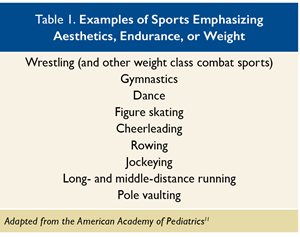
5 Athletes with REDs most commonly participate in endurance, aesthetic, or weight-class sports (see Table 1).
6
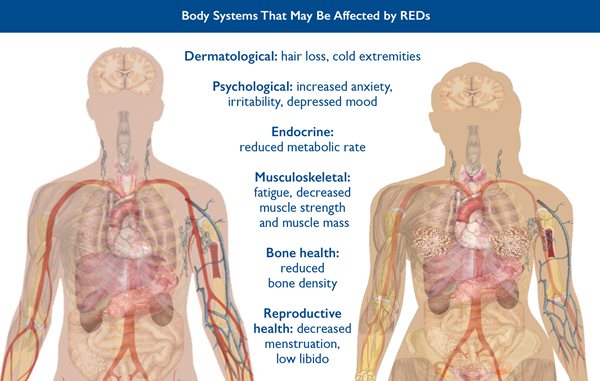
Prolonged low energy availability compromises multiple physiological systems, leading to decreased endurance, reduced muscle and bone strength, impaired concentration and coordination, and potential fertility issues.
REDs also increases the risk of injury, delays healing, and contributes to impaired judgment and depression.
7 In the female athlete, one of the most severe consequences is menstrual dysfunction, including loss of regular menstruation and ultimately amenorrhea, which is a part of the female athlete triad.
8 Adolescent athletes are also particularly vulnerable to long-term consequences because REDs can disrupt the critical period of bone mass accumulation.
9
REDs in the Male Athlete
Research on the impact of REDs in the male athlete has increased since the International Olympic Committee’s 2014 statement, with hundreds of articles highlighting the impact of REDs on male athletes.
2 Factors contributing to REDs in males vary and are often unique to the sport itself, such as making weight in wrestling.
10 Indications that a male athlete has REDs include decreased libido and decreased morning erections.
2
Male athletes are similarly at risk of fatigue, impaired bone health, and decreased performance, along with many of the concerns that impact female athletes. Clinicians, coaches, and athletic trainers can help by recognizing symptoms of REDs in male athletes.
PRE-PARTICIPATION EXAM
Clinicians managing an athlete’s health care have a unique opportunity because they can see the entire picture of a patient’s health and understand the complexities of each body system. Many athletes will appear at their primary care office for an annual sports physical or annual physical examination.
The annual sports physical is an opportunity to address the risk for REDs. Important questions to ask athletes include
11,12:
- Have you ever had a menstrual period?
- How old were you when you had your first menstrual period?
- When was your most recent menstrual period?
- How many periods have you had in the past 12 months?
- Are you presently taking any female hormones (estrogen, progesterone, birth control pills)?
- Do you worry about your weight?
- Are you trying to or has anyone recommended that you gain or lose weight?
- Are you on a special diet or do you avoid certain types of foods or food groups?
- Have you ever had an eating disorder?
- Have you ever had a stress fracture?
- Have you ever been told you have low bone density?
These are all risk factors that can be assessed in the PPE or annual physical examination with the athlete. There is also a portion of the Pennsylvania Interscholastic Athletic Association (PIAA) PPE that includes similar screening questions. Identifying athletes at risk of REDs early on is crucial to help prevent the deleterious impact on an athlete’s health. Diagnosis can be in conjunction with a multidisciplinary team including a physician or other clinician, dietitian, and mental health professional.
12
 Drawings by Mikael Häggström, CC0, via Wikimedia Commons
SCREENING
Drawings by Mikael Häggström, CC0, via Wikimedia Commons
SCREENING
Screening tools can be utilized to determine if an athlete is at risk for REDs. Commonly used screening tools include LEAF-Q screening for female athletes over 18 years old, LEAM-Q for male athletes over 18 years old, and REDs specific screening tool (RST) for athletes 11-18 years old.
13-15 LEAF-Q includes questions about injuries, gastrointestinal function, menstrual function, and use of contraceptives. LEAM-Q includes questions about dizziness, gastrointestinal function, body temperature regulation, illness, injury, energy, and libido.
Research suggests that decreased libido was one of the most effective self-reported symptoms to help identify male athletes who require further clinical assessment for low energy availability.
14 RST prompts the clinician to ask similar questions, including screening for eating disorders, depression, anemia, and time spent doing sport in a child-friendly manner with screening tools for male and female athletes.
After completing screening, if the athlete demonstrates that they are at risk of having REDs, the clinician can proceed to risk assessment as below. Positive screening depends on the tool used.
RISK ASSESSMENT
The first risk assessment introduced was the REDs Clinical Assessment Tool (CAT) in 2014, which was replaced by REDs CAT2 in 2023. In the original risk assessment, the athlete was categorized into green, yellow, and red risk categories based on clinical criteria; the new update includes all the previously mentioned criteria in addition to orange, which is an intermediate category.
2
Table 2 lists potential indicators of the REDs CAT in athletes.
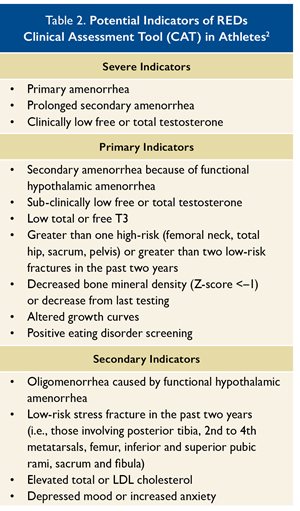
Risk category green is very low risk with no primary indicators and at most one secondary indicator. Risk category yellow is mild risk with up to two primary indicators or greater than two secondary indicators. Risk category orange is moderate to high with three primary indicators or two primary and greater than two secondary indicators. Risk category red is an extreme risk with greater than four primary indicators or three primary and greater than two secondary indicators.
2
WORKUP
Labs and imaging can assist in diagnosis and risk stratification of REDs, as well as evaluation for secondary causes of symptoms in athletes that are suspected or diagnosed with REDs.
Athletes suspected of having REDs can include those with menstrual dysfunction, stress fractures, disordered eating, unexplained performance decline, significant fatigue, and difficulty recovering from training.
REDs DIAGNOSTIC CODES
The diagnosis of REDs can be coded using the symptoms that make up the syndrome.
Examples might include:
Other fatigue R 53.83
Amenorrhea N 91.0 or N 91.9
Oligomenorrhea N 91.5
Decrease libido R 68.82
Osteopenia M 85.80
Depressed mood F 32.9
For all athletes suspected of having REDs, basic bloodwork including CBC, CMP, TSH, T3, and total cholesterol is recommended.
2
Athletes who are experiencing menstrual dysfunction — including primary amenorrhea, secondary amenorrhea, and oligomenorrhea — should have the initial workup described above for all athletes, as well as β-hcg, prolactin, FSH, LH, estradiol, and pelvic ultrasound (see Fig. 1).
16
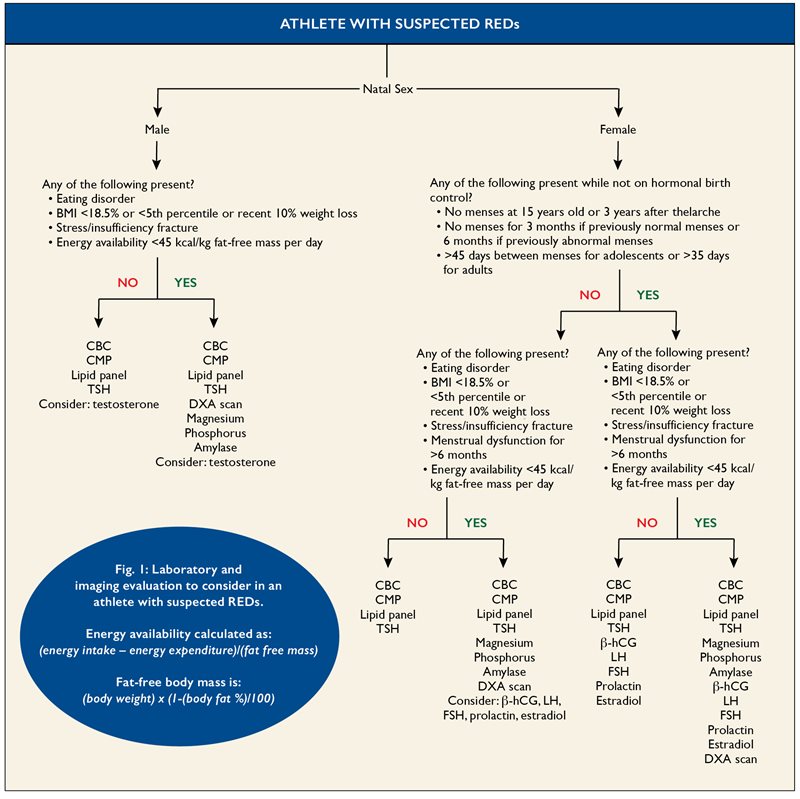
Athletes who have been diagnosed with eating disorders may need lab work including CBC, CMP, magnesium, phosphorus, amylase, TSH, and a lipid panel.
17
When helping male athletes, in addition to the basic bloodwork for all athletes described in Fig. 1, consider a testosterone level, especially in male athletes with decreased morning erections or decreased libido.
11
Additionally, dual-energy X-ray absorptiometry (DXA) scans are recommended if an athlete has an eating disorder, BMI under 18.5 or BMI under the 5th percentile, greater than 10% recent weight loss, menstrual dysfunction, low energy availability for greater than six months, or a history of stress/insufficiency fracture.
9 Though fracture risk cannot be determined by DXA scans in pre-menopausal athletes, any Z-score less than –1 should be investigated as low bone density since athletes generally have 10% to 15% higher bone densities than comparable populations.
18,19
It should be noted that in pre-menopausal athletes, a Z-score of less than 2 is insufficient to diagnose osteoporosis; additional risk factors such as nutritional deficiencies, hypoestrogenism, or stress fracture must also be present.
19 In pediatric populations, bone mineral density will likely “catch up” after treatment, yet prolonged REDs and LEA can cause longstanding decreased bone mineral density.
9
If low bone density is identified, additional bloodwork is recommended, including vitamin D, calcium, CBC, TSH, PTH, bone alkaline phosphatase, and 24-hour urine calcium. Clinicians can also consider cortisol, osteocalcin, and urine N-telopeptide. Finally, workup may need to include FSH, LH, estradiol for natal females, and testosterone for natal males.
9
MANAGEMENT AND RETURN TO PLAY
As with any syndrome, management should begin with primary prevention. Clinicians can provide nutritional education to athletes, parents, and coaches, especially those involved in high-risk sports for REDs as described above (see Table 1).
2
Management of REDs is focused on achieving the balance between caloric intake and energy expenditure.
6 The primary management should be non-pharmacological with changes to diet and exercise.
2 Depending on the patient’s risk, consulting a dietician or psychologist may be necessary.
Clinicians may consider a referral to a specialist in the areas of sports psychology, sports nutrition, endocrinology, OB-GYN, or primary care sports medicine for additional management. Sports psychology and sports nutrition services can assist in identifying and managing the psychological drivers that impact nutritional intake. Specialists in endocrinology can help manage hormonal dysfunctions, and OB-GYN can help manage menstrual dysfunctions.
It is important to differentiate between menstrual dysfunction caused by REDs in the female athlete versus menstrual dysfunction of organic origin. Menstrual dysfunction due to nutritional deficiencies may improve with appropriate intake of food and calories. Importantly, oral contraceptive pills are not recommended as primary treatment because helping patients resume menstruation without addressing the nutritional deficiencies can mask one of the markers of REDs. Reassessment is recommended at one- to three-month intervals.
7
Based on the REDs CAT2 model, risk is stratified into green, yellow, orange, and red as previously discussed. For athletes in the green category, no intervention is recommended with no restrictions. Athletes in the yellow risk category can train and compete without restrictions; however, they may require regular treatment and monitoring.
Athletes in the orange risk category may need activity modification as well as monthly monitoring and treatment.
Athletes in the red category are generally removed from training and competition. Treatment for these athletes at highest risk for significant injury from REDs should be immediate, and hospitalization should be considered depending on clinical situation. They will need ongoing monitoring, at daily to monthly intervals, as they progress toward recovery.
CONCLUSION
REDs can be challenging to diagnose and manage and can affect patients in many ways. Clinicians should be comfortable with the initial screening and management of athletes for whom they care. They should recognize that symptoms can be present in any athlete and thus all athletes should be screened for REDs.
Utilizing a multidisciplinary team can increase the success of the patient being able to return to activity/sport safely. Managing REDs requires restoring the balance between caloric intake and energy expenditure, ideally through non-pharmacological means.
KEY TAKEAWAYS
► Relative energy deficiency in sport (REDs) is a more encompassing term built on the foundation of female athlete triad that includes male athletes and expands our understanding to include other affected organ systems.
► Clinicians should understand the basic symptoms of REDs and how the disorder can impact an athlete.
► Clinicians should be comfortable screening for REDs at an athlete’s pre-participation physical or annual physical examination.
► Utilizing a multidisciplinary team will assist in more comprehensive care of the athlete.
► Raising awareness among clinicians, coaches, and athletic trainers will help identify more athletes at risk of REDs.
► Athletes need periodic check-ups for reassessment.
REFERENCES
1. Mountjoy M, Sundgot-Borgen J, Burke L, et al. The IOC consensus statement: beyond the female athlete triad — Relative Energy Deficiency in Sport (RED-S).
Br J Sports Med. 2014;48(7):491-497.
2. Mountjoy M, Ackerman KE, Bailey DM, et al. 2023 International Olympic Committee’s (IOC) consensus statement on Relative Energy Deficiency in Sport (REDs).
Br J Sports Med. 2023;57(17):1073-1097.
3. Nickols R. What is Relative Energy Deficiency in Sport (REDs)? National Eating Disorders Association. March 4, 2024. Accessed May 4, 2026.
https://www.nationaleatingdisorders.org/relative-energy-deficiency-in-sport-red-s/
4. Relative Energy Deficiency in Sport (REDs). Boston Children’s Hospital. Accessed May 4, 2026.
https://www.childrenshospital.org/conditions-treatments/reds
5. Kroshus E, Fischer AN, Nichols JF. Assessing the awareness and behaviors of U.S. high school nurses with respect to the female athlete triad.
J Sch Nurs. 2015;31(4):272-279.
6. Logue DM, Madigan SM, Melin A, et al. Low energy availability in athletes 2020: an updated narrative review of prevalence, risk, within-day energy balance, knowledge, and impact on sports performance.
Nutrients. 2020;12(3):835.
7. Wojnowich K, Dhani R. Care of the active female.
Am Fam Physician. 2022;106(1):52-60.
8. Cabre HE, Moore SR, Smith-Ryan AE, Hackney AC. Relative Energy Deficiency in Sport (RED-S): scientific, clinical, and practical implications for the female athlete.
Dtsch Z Sportmed. 2022;73(7):225-234.
9. Weiss Kelly AK, Hecht S; Council on Sports Medicine and Fitness. The female athlete triad.
Pediatrics. 2016;138(2):e20160922.
10. Mountjoy M, Sundgot-Borgen JK, Burke LM, et al. IOC consensus statement on Relative Energy Deficiency in Sport (RED-S): 2018 update.
Br J Sports Med. 2018;52(11):687-697.
11. Carl RL, Johnson MD, Martin TJ; Council on Sports Medicine and Fitness. Promotion of healthy weight-control practices in young athletes.
Pediatrics. 2017;140(3):e20171871.
12. De Souza MJ, Nattiv A, Joy E, et al. 2014 female athlete triad coalition consensus statement on treatment and return to play of the female athlete triad: 1st international conference held in San Francisco, California, May 2012 and 2nd international conference held in Indianapolis, Indiana, May 2013.
Br J Sports Med. 2014;48(4):289.
13. Melin A, Tornberg AB, Skouby S, et al. The LEAF questionnaire: a screening tool for the identification of female athletes at risk for the female athlete triad.
Br J Sports Med. 2014;48(7):540-545.
14. Lundy B, Torstveit MK, Stenqvist TB, et al. Screening for low energy availability in male athletes: attempted validation of LEAM-Q.
Nutrients. 2022;14(9):1873.
15. Foley Davelaar CM, Ostrom M, Schulz J, Trane K, Wolkin A, Granger J. Validation of an age-appropriate screening tool for female athlete triad and Relative Energy Deficiency in Sport in young athletes.
Cureus. 2020;12(6):e8579.
16. Klein DA, Paradise SL, Reeder RM. Amenorrhea: a systematic approach to diagnosis and management.
Am Fam Physician. 2019;100(1):39-48.
17. Klein DA, Sylvester JE, Schvey NA. Eating disorders in primary care: diagnosis and management.
Am Fam Physician. 2021;103(1):22-32. Erratum in:
Am Fam Physician. 2021;103(5):263.
18. Fehling PC, Alekel L, Clasey J, Rector A, Stillman RJ. A comparison of bone mineral densities among female athletes in impact loading and active loading sports.
Bone. 1995;17(3):205-210.
19. Nattiv A, Loucks AB, Manore MM, et al. American College of Sports Medicine position stand. The female athlete triad.
Med Sci Sports Exerc. 2007;39(10):1867-1882.