Fall 2026 - Vol. 21, No. 3
PERSPECTIVE
When Ideology Dictates Science
Modern-Day Lysenkoism at the U.S. Department of Health and Human Services
Kenneth W. Lin, MD, MPH
Associate Director, Family Medicine Residency Program
Penn Medicine Lancaster General Health
The headline of an unsigned editorial in
The Lancet assessing Secretary of Health and Human Services (HHS) Robert F. Kennedy, Jr.’s first year in office did not mince words: “1 Year of Failure.” The editorial contrasted Kennedy’s promises during his Senate confirmation hearings to promote transparency and “gold standard science” with his actions as the head of HHS: widespread layoffs, deletions of public health data sets, dismissals or wholesale replacements of scientific advisory panels, and tepid responses to pertussis and measles outbreaks. “The destruction that Kennedy has wrought in 1 year might take generations to repair,” it concluded, “and there is little hope for U.S. health and science while he remains at the helm.”
1
News reports have described the damage that Secretary Kennedy has wrought to the Centers for Disease Control and Prevention (CDC), the National Institutes of Health (NIH), and other scientific institutions that comprise the Department of HHS as unprecedented, which is true in the American context. However, there is an historic precedent for using ideology to dictate science policy and silence critics: Trofim Lysenko, a high-ranking official whose pseudoscientific theories dominated Soviet agriculture from the mid-1930s to the 1960s.
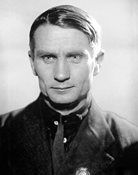 Trofim Lysenko
LYSENKOISM IN THE SOVIET UNION
Trofim Lysenko
LYSENKOISM IN THE SOVIET UNION
With only two years of formal grade school education, and despite not being able to read and write until age 13, Lysenko was an unlikely future agronomist who came of age during the Russian Revolution. Seeking to suppress political dissent after the Communist Party’s violent seizure of power, Vladimir Lenin exiled more than 2,000 intellectuals, including scientists, and placed others under arrest. Party leaders sought suitable replacements from the working class — and Lysenko, the son of Ukrainian peasants, fit the profile.
2
In the late 1920s, the USSR experienced widespread famines due to Joseph Stalin’s policy of forced farm collectivization. Lysenko came to the attention of Communist leaders when he advanced a theory that treating soaked seeds at low temperatures (“vernalization”) could change plant physiology and lead to abundant crop yields.
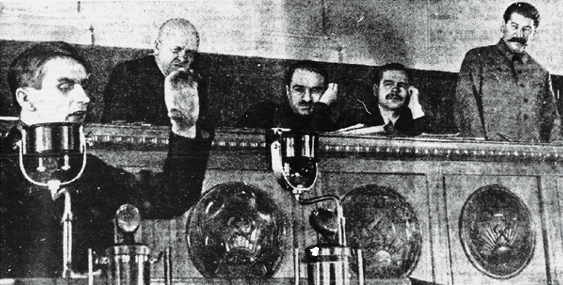 Trofim Lysenko (left) speaking at the Kremlin in 1935. He was a long-time favorite of Joseph Stalin (far right).
Promising rapid results, he rejected Mendelian genetics as capitalist and “bourgeois” and instead posited that plants could inherit acquired characteristics. Studies generally failed to support his theories, but Lysenko, who had only rudimentary statistical training, rose in the scientific hierarchy by making claims based on socialist ideology rather than verifiable knowledge: “He started with conclusions and cherry-picked the evidence, ignored contrary evidence to support it or made things up.”
3
During the 1930s, dozens of prominent scientists who opposed Lysenko’s scientific arguments were targeted by political smear campaigns and were demoted, imprisoned, or executed. Nikolai Vavilov, an internationally renowned Russian plant geneticist who founded the first large-scale seed bank, was publicly denounced by Lysenko at several conferences, arrested in 1940 for “sabotage and espionage,” and starved to death in prison in 1943. It is worth noting that Vavilov and other politically persecuted scientists during this time period were posthumously “rehabilitated” decades later.
Although other biologists and agronomists were open to considering his ideas, by the mid-1940s much of the Soviet scientific community had turned against Lysenko’s totalitarian style, warning that suppression of genetic science in favor of unproven ideologically based theories was crippling Soviet agriculture. In response, Lysenko appealed to his patron, Stalin, for support. In July 1948, at Stalin’s request, the Politburo, the Communist Party’s executive governing body, passed a unanimous declaration that decisions based on genetics research should be prohibited in the Soviet Union.
At the August 1948 session of the Lenin All-Union Academy of Agricultural Science, Lysenko pushed through a similar decree that expressly forbade all genetic research and discussions of the subject. As a result, several thousand geneticists in the USSR were forced to recant their previous views under threat of dismissal from their positions and closure of their laboratories.
4
How did Lysenko and his followers retain control of Soviet science for decades even though his theories had no empirical foundations? The historian Loren Graham observed:
The ideological fervor with which Lysenko surrounded his work, his constant declarations that he was transforming Soviet agriculture for the good of the Soviet state, meant that few people were willing to criticize his results; such criticism could easily be interpreted as a lack of enthusiasm for the goal of socialist agriculture. Lysenko frequently cast his critics in that light. This political atmosphere fostered the emergence of a circle of sycophants around Lysenko who enthusiastically claimed victory after victory for his methods.… He developed his various nostrums so rapidly that before the academic biologists could show that one was valueless or harmful, Lysenko was off announcing another technology.
5
Eventually, despite Lysenko’s attempts to blame disappointing crop yields on peasant farmer recalcitrance or laziness — an ironic position, considering his origins — the failures of Soviet agriculture caused by abandoning genetics became too obvious for politicians to ignore. As the Soviet Union made strenuous efforts to catch up to and surpass the United States in scientific achievement after Stalin’s death in 1953, his successor, Nikita Khrushchev, relaxed censorship as part of a policy of de-Stalinization.
However, Lysenko continued to serve as an official agricultural advisor until Khrushchev’s removal from power in 1964. Lysenko’s scientific allies held prominent positions in agricultural higher education into the early 1980s.
LYSENKOISM AT HHS
Unlike nearly all of his predecessors, Kennedy is not a scientist, former governor, or veteran administrator. The scion of a political dynasty, he was an environmental lawyer, 2024 Presidential candidate, and longtime antivaccine activist. He founded Children’s Health Defense, a group that blames vaccines for increasing diagnoses of autism and other chronic childhood conditions. As chairman of Children’s Health Defense, Kennedy spoke out against measles, mumps, and rubella (MMR) vaccination in Samoa, causing vaccination rates to plummet and fueling a measles outbreak in 2019 that resulted in 5,700 cases and 83 deaths, mostly among young children.
6
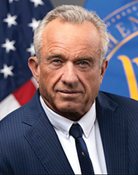 Sec. Robert F. Kennedy, Jr.
In 2021, the Center for Countering Digital Hate named him one of the “Disinformation Dozen,” a group of 12 individuals or groups responsible for 65% of antivaccine disinformation online. When baseball legend Hank Aaron died in January 2021, two weeks after receiving a COVID-19 vaccine, Kennedy issued a statement insinuating that the vaccine had caused Aaron’s death.
7
Louisiana senator Bill Cassidy, a gastroenterologist who chaired the Senate Health, Education, Labor and Pensions (HELP) Committee, announced in February 2025 that he would cast a critical vote to confirm Kennedy as HHS Secretary in exchange for promises to protect access to and not sow public fear about vaccines, maintain recommendations from the CDC’s Advisory Committee on Immunization Practices (ACIP), and not remove statements on the CDC’s website pointing out that vaccines do not cause autism.
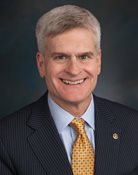
Sen. Bill Cassidy
Once in office, Secretary Kennedy began breaking each of his promises to Cassidy. On February 14, 2025, he directed the CDC to “pull out of circulation all campaign ad buys related to the flu or anything encouraging shots or vaccinations”
8 (see Fig. 1).
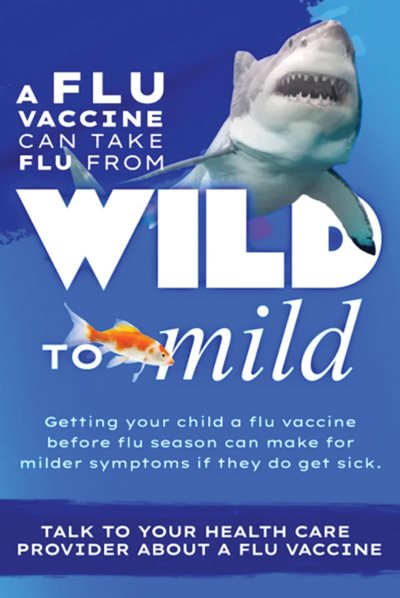
Fig. 1. One of the ads included in the CDC’s “Wild to Mild” flu vaccine campaign that was pulled from circulation on February 14, 2025.
On May 27, 2025, he unilaterally removed COVID-19 vaccine recommendations for healthy children and pregnant women from the CDC’s immunization schedules.
9 On June 9, 2025, he replaced the entire ACIP with a smaller panel that included a single pediatrician, no family physicians, and several people affiliated with antivaccine groups.
Meeting three times in 2025, the reconstituted ACIP repeatedly disregarded its established processes for assessing evidence to make questionable recommendations on thimerosal, MMR-varicella vaccine, and hepatitis B vaccine.
10 In early August, the CDC barred medical societies, including the American Academy of Pediatrics (AAP) and the American Academy of Family Physicians, from participating in ACIP work groups, asserting that these societies were “biased” because their members took care of patients.
11 Later that month, Kennedy fired Dr. Susan Monarez, his recently confirmed CDC director, for resisting changes to vaccine recommendations.
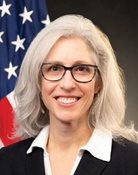 Dr. Susan Monarez
On November 19, 2025, the CDC’s webpage on autism and vaccines was altered to add an asterisk to the Cassidy-required headline “Vaccines Do Not Cause Autism,” while the remainder of the page presented a list of misleading and spurious claims that suggest that vaccines do, indeed, cause autism.
12
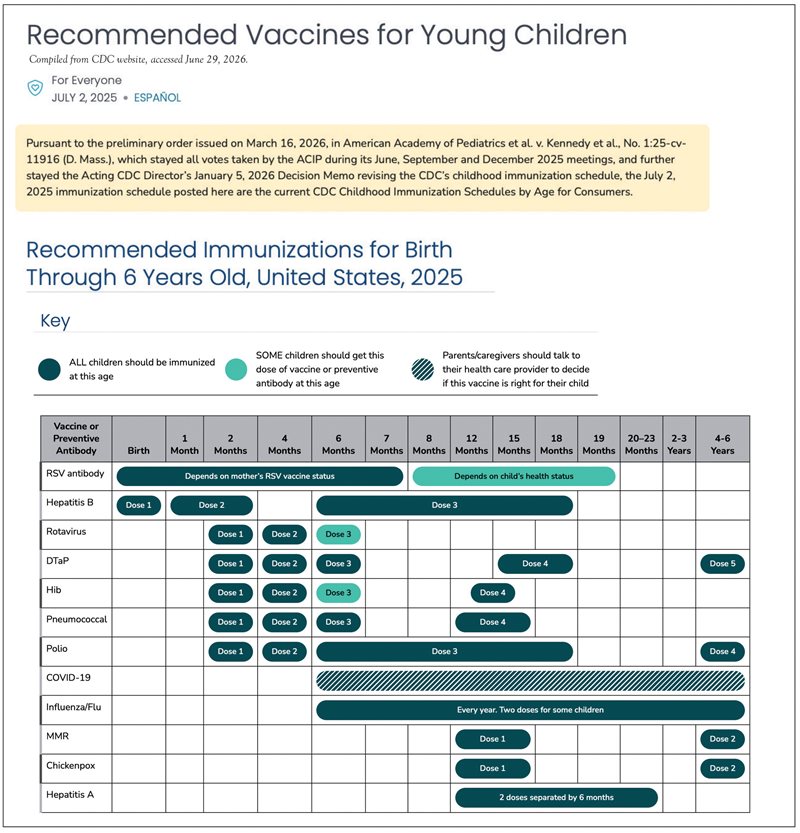
On January 5, 2026, HHS changed the CDC’s immunization schedule, making six vaccines — rotavirus, COVID-19, influenza, meningococcal disease ACWY and B, hepatitis A, and hepatitis B — optional after “shared clinical decision-making”; these were previously recommended for all children. In response to a lawsuit led by the AAP, a federal court in Massachusetts subsequently issued an injunction that blocked HHS from implementing the new schedule (see below).
Under Kennedy, the CDC and FDA forced their scientists to withdraw studies that had been accepted to medical journals showing that updated COVID-19 vaccines were effective and safe,
13 and the NIH terminated dozens of active research grants on vaccine hesitancy and promotion of underutilized vaccines.
14 Nearly half of public health databases maintained by the CDC that had been updated at least monthly prior to Kennedy’s arrival had unexplained pauses in 2025; 87% of those paused databases reported information about vaccinations, most commonly influenza, COVID-19, and respiratory syncytial virus.
15 On December 30, 2025, the Centers for Medicare and Medicaid Services notified state health officials that at Kennedy’s discretion, pediatric and prenatal immunization rates had been removed from the Core Sets that measure health care performance.
16
Several other long-established HHS advisory groups were dissolved or had their operations suspended in 2025, most notably the U.S. Preventive Services Task Force (USPSTF). When news surfaced in July that Kennedy was considering dissolving the USPSTF as he had the ACIP — reportedly for being “too woke” in its focus on equity in preventive services — hundreds of medical organizations rallied to its defense. Instead of dissolving the panel, Kennedy canceled each of its past four meetings, attributing one cancellation to the federal government shutdown but offering no explanation for the others. Further, he has not appointed replacements for the five members whose terms expired on January 1, 2026.
17
Summing up current threats to the integrity of scientific advisory groups in Kennedy’s HHS, Robert Lawrence, MD, and Steven Woolf, MD, employed language similar to that used to describe Lysenko’s reign over Soviet science:
What is happening to scientific advisory groups under the current administration poses a larger threat to evidence-based policy and could easily return health care and public health practice in the United States to the conditions of the early 1980s.… Once again, practice recommendations are being made without comprehensive examination of all relevant evidence. Study findings are being accepted at face value without attention to design flaws. Data are being cherry-picked to conform with biases, beliefs, or ideology.
18
Ideology is a powerful tool for marginalizing or silencing scientific opponents, but it cannot feed people or protect them against infectious diseases. During the height of Lysenko’s influence in the 1940s, the Soviet Union was repeatedly threatened by famines and needed to import massive quantities of grain from the United States to sustain its population. The full consequences of Kennedy’s actions to cast doubt on the safety of childhood vaccines may not be known for years, though 2025 and 2026 have seen the highest numbers of U.S. measles cases in the past three decades.
A recent modeling study projected future numbers of cases and complications of measles and other vaccine-preventable infections in scenarios of stagnant or declining vaccination rates. At current state-level MMR vaccination rates, which are below the 95% threshold recommended to achieve adequate herd immunity, there is an 83% chance that measles will again become endemic in the United States, with 850,000 cases and 2,550 deaths expected during the next 25 years. If MMR vaccination rates were to fall by 10%, 11.1 million cases and at least 11,000 deaths would be expected during that timeframe.
19
CONCLUSION
The actions of Secretary Kennedy during his first year at HHS have many troubling similarities to those actions taken by Trofim Lysenko on Soviet agriculture. Fortunately, the United States is not the former Soviet Union. Although thousands have been dismissed from positions at federal agencies or have lost their research funding, U.S. scientists cannot be imprisoned by the state for producing politically inconvenient results and writing or speaking about them in public forums. As the AAP’s lawsuit illustrates, there may be viable legal remedies to the worst of Kennedy’s abuses of public health institutions.
Primary care clinicians have mostly chosen to disregard the CDC’s modified vaccine schedules in favor of evidence-based recommendations from the AAP that have been widely endorsed by major medical societies.
20,21 Many states have acted to preserve access to vaccines that are no longer routinely recommended by HHS.
22
I encourage readers of this article to join their respective professional societies and state health departments in resisting attacks on national infectious disease and prevention guidelines to protect our patients and the public's health.
Need more help with vaccine hesitancy? Want to understand clinical recommendations better?
► Click here to read the 2025 JLGH article on vaccine hesitancy with case example.
► Click here for practical talking points from two LG Health pediatricians.
REFERENCES
1. The Lancet. Robert F. Kennedy Jr: 1 year of failure.
Lancet. 2026;407(10531):825.
2. Soyfer VN. The consequences of political dictatorship for Russian science.
Nat Rev Genet. 2001;2(9):723-729.
3. Poole R. Remembering Lysenko: when ideology and science meet.
Br J Psychiatry. 2026;228(4):297-299.
4. Borinskaya SA, Ermolaev AI, Kolchinsky EI. Lysenkoism against genetics: the meeting of the Lenin All-Union Academy of Agricultural Sciences of August 1948, its background, causes, and aftermath.
Genetics. 2019;212(1):1-12.
5. Graham LR.
Science in Russia and the Soviet Union: A Short History. Cambridge University Press, 1993.
6. Mann ME, Hotez PJ.
Science Under Siege: How to Fight the Five Most Powerful Forces that Threaten Our World. New York: Public Affairs, 2025.
7. Morabia A. Hank Aaron, Robert F. Kennedy Jr, and the public’s health.
Am J Public Health. 2025;115(2):108-109.
8. Stolberg SG. Inside the CDC’s mad scramble to meet Kennedy’s demands. The New York Times. June 25, 2026. Accessed June 29, 2026.
https://www.nytimes.com/2026/06/25/us/politics/kennedy-cdc-emails.html
9. Schwartz JL. Revised recommendations for Covid-19 vaccines: U.S. vaccination policy under threat.
N Engl J Med. 2025;393:417-419.
10. Campos-Outcalt D, Temte J. Advisory Committee on Immunization Practices standards for assessing evidence.
JAMA. 2025;334(23):2063-2064.
11. Ault A. CDC bars medical organizations from ACIP work groups, charging bias. Medscape. August 5, 2025. Accessed June 29, 2026.
https://www.medscape.com/viewarticle/cdc-bars-medical-organizations-acip-work-groups-charging-2025a1000kqj
12. Autism and Vaccines. Centers for Disease Control and Prevention. November 19, 2025. Accessed June 29, 2026.
https://www.cdc.gov/vaccine-safety/about/autism.html
13. Jewett C. FDA blocked publication of research finding Covid and shingles vaccines were safe. The New York Times. May 5, 2026. Accessed June 29, 2026.
https://www.nytimes.com/2026/05/05/us/politics/fda-covid-vaccine-studies.html
14. Motta M, Callaghan T, Ulrich MR, McCuskey EY, Huberfeld N. Attacks on vaccine hesitancy and promotion research undermine public health. Health Affairs. March 3, 2026. Accessed June 29, 2026.
https://www.healthaffairs.org/content/forefront/attacks-vaccine-hesitancy-and-promotion-research-undermine-public-health
15. Jacobs JW, Booth GS, Brewer NT, Freilich J. Unexplained pauses in Centers for Disease Control and Prevention surveillance: erosion of the public evidence base for health policy.
Ann Intern Med. 2026;179(3):425-459.
16. Anderer S. CMS: states no longer required to report immunizations.
JAMA. 2026;335(12):1024.
17. Howard J, Luhby T. The task force that shapes Americans’ preventive care has not met in a year. Doctors now worry it’s being ‘abandoned’ by HHS. CNN. March 3, 2026. Accessed June 29, 2026.
https://www.cnn.com/2026/03/03/health/uspstf-preventive-care-hhs
18. Lawrence RS, Woolf SH. The current threat to the U.S. Preventive Services Task Force and why it matters.
Ann Intern Med. 2026;179(5):744-745.
19. Kiang MV, Bubar KM, Maldonado Y, Hotez PJ, Lo NC. Modeling reemergence of vaccine-eliminated infectious diseases under declining vaccination in the US.
JAMA. 2025;333(24):2176-2187.
20. Lin K. Who should PCPs look to for vaccine recommendations? Medscape. August 26, 2025. Accessed June 29, 2026.
https://www.medscape.com/viewarticle/who-should-pcps-look-vaccine-recommendations-2025a1000mas
21. Goldman JM, Mitchell KM, Hopkins RH Jr. The importance of the childhood immunization schedule for internal medicine.
Ann Intern Med. 2026;179(6):885-888.
22. Killelea A, Giovannelli J, Harden-Stein M, Knapp A. How states are preserving science-backed recommendations for preventive care and vaccines. The Commonwealth Fund. December 15, 2025. Accessed June 29, 2026.
https://www.commonwealthfund.org/blog/2025/how-states-are-preserving-science-backed-recommendations-preventive-care-and-vaccines