Fall 2026 - Vol. 21, No. 3
CLINICAL REPORT
Safe Mobility for Life
The Driving Edition


Mercier Hilal
Alison Mercier, MD
Associate Program Director, Geriatrics
Penn Medicine Lancaster General Health Physicians
Olivia Hilal, MD
Geriatric Medicine Fellow
Penn Medicine Lancaster General Health Physicians
In most areas of the country, driving is paramount for access to basic necessities, such as food and medical care, as well as independence and socialization. These are critical for health maintenance and quality of life. In fact, those who retire from driving are at risk for social isolation, depression, and functional decline.
1
Driving is a complex task requiring skills across many domains of function including vision, mobility, hearing, and cognition. These functions are likely to change as we age, in part due to the physiologic aging process. The number of older adult drivers — defined as adults above the age of 65 years — has increased by 24% over the past 10 years in Pennsylvania.
This is one of the only segments of the population that saw an increase in the number of fatal crashes from 2024 to 2025. Nationally, motor vehicle injuries are the leading cause of injury-related deaths in older adults aged 65 to 74 years and the second leading cause in patients aged 75 to 84 years.
2
There are many challenging aspects when evaluating older adult driving safety in the context of a time-limited outpatient appointment. Primary care clinicians are well poised to help older adults maintain driving safety and/or plan for driving retirement due to their longitudinal relationships with their patients.
Clinicians must recognize warning signs to prompt a thorough assessment of risk and how urgently evaluations should take place. To make this possible, clinicians should use validated tools that predict driving safety while maintaining therapeutic rapport.
Given that driving is a link to community and fosters independence, clinicians must carefully consider driving cessation, balancing benefit to the individual with risk to self and others. This article aims to review objective tools that are predictive of poor driving safety. These tools may improve identification of drivers who are at risk for serious driving-related events and increase driving safety while helping drivers transition to driving retirement.
SCREENING
While there are no specific guidelines to recommend screening for driving safety, we can normalize the conversation by suggesting annual screening. This can allow for routine review of warning signs for unsafe driving and help patients plan for driving retirement.
Screening patients for driving preparedness can also cue the patient to look into their auto insurance policy to ensure they are paying for the appropriate coverage. Further, Mature Driver Improvement courses are available through the Pennsylvania Department of Transportation (PennDOT) for people aged 55 years and older; patients may be eligible for a 5% discount on vehicle insurance once the course is completed. These courses may require a small fee, and a refresher course must be completed every three years to maintain the discount.
The American Geriatric Society (AGS) recommends a brief outpatient screening tool — the “4 Cs” — for assessing and counseling the older adult driver; portions of the tool can be completed prior to the office visit. This tool uses direct observation and clinical history to determine driving safety concerns. It evaluates four domains that reliably predict crash risk, including:
Crash history, family
Concerns,
Clinical status, and
Cognition. Overall, a score of 9 or more points has been shown to identify 84% of participants who are at risk for poor road test performance
3 (see Table 1).
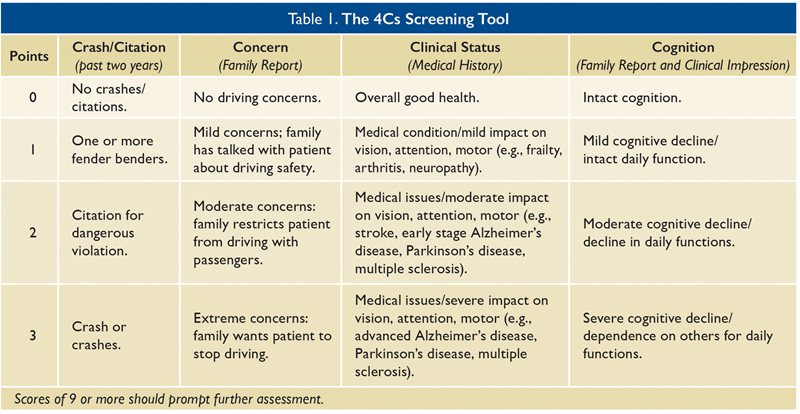
A positive screening test with the 4Cs should prompt clinicians to conduct a comprehensive evaluation to identify and correct reversible factors for driving safety. Other triggers to prompt driving evaluation are evidence of cognitive impairment, change in health condition, or decline in functional status.
Behavioral modifications or self-regulation while driving — such as avoiding night or winter driving, driving to familiar places, and/or avoiding busy highways — can be early signs of driving safety concerns. In fact, those who have reduced their mileage are at an increased risk for crashes.
4 PennDOT maintains a list of medical conditions that require reporting, which are detailed later in this article.
Many adults assume they will continue driving in perpetuity; recommending that patients complete a driver safety evaluation can come as a surprise. People who are questioned regarding their capacity to drive may become emotional or defensive; they may feel mistrusted, as if they have failed in some way or as if questioning suggests they will be punished. Normalizing the conversation, using objective tools, engaging family and friends, validating emotions, and planning for transitions can preserve dignity and help maintain the therapeutic relationship during this process.
CLINICAL ASSESSMENT
Once risk factors have been identified, further evaluation can be incorporated into a clinic visit using a standardized clinical framework. Clinical Assessment of Driving Related Skills (CADReS) is a comprehensive tool to categorize driving safety deficits and can be tailored to an individual patient.
5 The tool considers general assessment, vision, cognition, and motor/sensory deficits. Some of these questions may be redundant if the 4Cs screening has been completed.
For the general assessment, clinicians should establish a patient’s baseline functional status, including all activities of daily living (ADLs) and instrumental activities of daily living (IADLs). Difficulty with two or more IADLs is a strong predictor of poor driving safety.
6 If the 4Cs screening has not been completed, it is important to obtain a thorough driving history.
Reviewing recent medication changes, as well as currently prescribed and over-the-counter medications, can help clinicians identify Potentially Inappropriate Medications (PIMs), as defined by the 2023 AGS Beers Criteria.
7 Older adults are more susceptible to medication side effects because pharmacokinetics change with age. Finding ways to decrease the use of PIMs — including medications that can be sedating and those with high anticholinergic burden — can help preserve the domains of function necessary for safe driving. Some helpful resources to identify PIMs and guide deprescribing include online anticholinergic calculators such as
acbcalc.com, and online deprescribing websites such as
deprescribing.org and
medstopper.com.
Vision can be more difficult to assess in the outpatient setting, and partnering with a local ophthalmologist can be valuable if there are underlying comorbidities or concerns for significant visual impairment. Visual evaluation should include acuity testing via the Snellen chart, confrontation testing and examination of visual fields, as well as evaluating contrast with a Pelli Robson chart.
Per Pennsylvania regulations, visual acuity should be at least 20/40 to maintain safe driving. Patients can still drive in daylight hours as long as their combined vision is 20/60 or better. Vision of 20/100 or worse should be evaluated by an ophthalmologist before a patient can obtain a restricted driver’s license.
Memory changes should prompt evaluation for driving risk. Objective cognitive assessment via the St. Louis University Mental Status (SLUMS) examination or the Montreal Cognitive Assessment (MoCA) test should be completed annually for those with cognitive concerns to trend strengths and weaknesses across multiple cognitive domains. Deficits in the visuospatial cognitive domain — often evaluated with trailmaking B and clock drawing tests — are the highest predictors of driving capabilities and should be used to inform driving cessation.
8
There is no definitive cut-off score on a SLUMS exam or a MoCA test to automatically revoke a license. Further evaluation should be completed if a patient scores 18 or less on a MoCA test, especially if deficits are noted in the visuospatial or executive function domain.
9 A diagnosis of mild cognitive impairment or early dementia doesn’t automatically imply driving risk. In fact, a recent study found that 76% of people with mild dementia were found fit to drive.
10
However, interval cognitive testing and driving history every six months to a year is appropriate to monitor for changes that impact the ability to drive. For more complex cases of memory loss, a referral to local specialists — such as LG Health Physicians Alzheimer’s and Memory Care or LG Health Physicians Geriatrics — may help provide appropriate guidance.
Finally, a thorough motor and sensory evaluation can help identify areas that may make driving more difficult. This could include Timed Up and Go (TUG) testing, proprioceptive testing, evaluation of gait abnormalities, and assessment of upper and lower extremity range of motion and strength, especially feet, arms, and neck. A 13.5-second or longer TUG indicates an increased risk of fall and/or mobility impairment.
11
ANALYSIS AND INTERVENTION
CADReS can be time consuming. If an at-risk driver is identified after completing a medication review and functional assessment, it is appropriate to collaborate with local occupational therapists (OTs) for an Advanced Life Skills Assessment (ALSA). Furthermore, OTs can provide additional objective driving safety evaluations to complement or augment clinician assessments. At Lancaster General Hospital (LGH), OTs perform a comprehensive assessment including, but not limited to:
- Falls-risk assessment.
- Cognitive assessment with the MoCA.
- Basic symbolic language assessment, for which patients may be asked to identify and respond to 10 traffic signs.
- A motor visual association test, including a visual memory test, an evaluation of processing length of time, and an eye-foot reaction.
- Visual acuity and visual field testing.
Clinical recommendations are made based on the aggregate assessment score and specific performance on these assessments. Recommendations can range from retirement from driving to a behind-the-wheel assessment, suggestions to optimize medical comorbidities/sensory domains, or a clearance to drive.
In the Lancaster area, some private companies offer out-of-pocket behind-the-wheel driving assessments. Not all driving centers will allow for the use of a personal vehicle, and most incur a fee to complete the evaluation. Once a behind-the-wheel examination is completed and a patient is found to be fit to drive, reassessment at routine intervals, as noted above, is important.
Specialists in audiology or ophthalmology may help to optimize hearing and vision, specialists in mental health care may assist with managing otherwise inadequately treated depression, and primary care clinicians may need to help stabilize medical comorbidities.
Occasionally, patients can be referred for further therapy to work on reversible deficits that may otherwise impair their ability to drive safely. Additionally, if motor performance is compromised, a referral to a vehicle adaptation center can make the car more functional. Adaptations may entail adding a handle mechanism to help with transfers, a leg lifter, or hand controls, among other upgrades. These can come at a cost but may be worthwhile to help individuals remain independent and connected to the community.
Typically, all these recommendations will be communicated to the referring clinician, who has the ultimate responsibility for reevaluation and next steps, including reporting to PennDOT as indicated. If no driving deficits are identified, the patient should be designated fit to drive.
Continued conversations about potential driving retirement, as well as annual screens for driving fitness, should remain a part of routine health care maintenance. See “Reporting to PennDOT” below for specifics on mandatory reporting based on medical comorbidities.
LIFE AFTER DRIVING CESSATION
Even if the clinician requests that the patient stop driving, it is important to help each patient retain as much independence as possible. Patients may still want a photo identification and can obtain their Pennsylvania State ID free of charge at the Department of Motor Vehicles (DMV); the application can be completed online. To help maintain access to the Lancaster community, patients can leverage the services of the Ambulatory Collaborative Care Team or social work team to create a plan that prioritizes transportation to places a patient goes, e.g., place of worship, grocery stores, pharmacies, and doctors’ offices.
REPORTING TO PENNDOT
As mandated by Pennsylvania law, clinicians are required to report health conditions that impact driving safety. PennDOT now has an online portal to make reports utilizing their General Medical Initial Reporting Form.
12 The form offers multiple options, including the suggestion that further driving evaluation is required.
It is worth noting that making that suggestion does not necessarily imply the patient must immediately cease driving. PennDOT has made available a list of medical comorbidities that, if unmanaged, would require immediate cessation of driving. Table 2 provides a general summary of PennDOT’s Medical Criteria and Chapter 83/71 regulations pages.
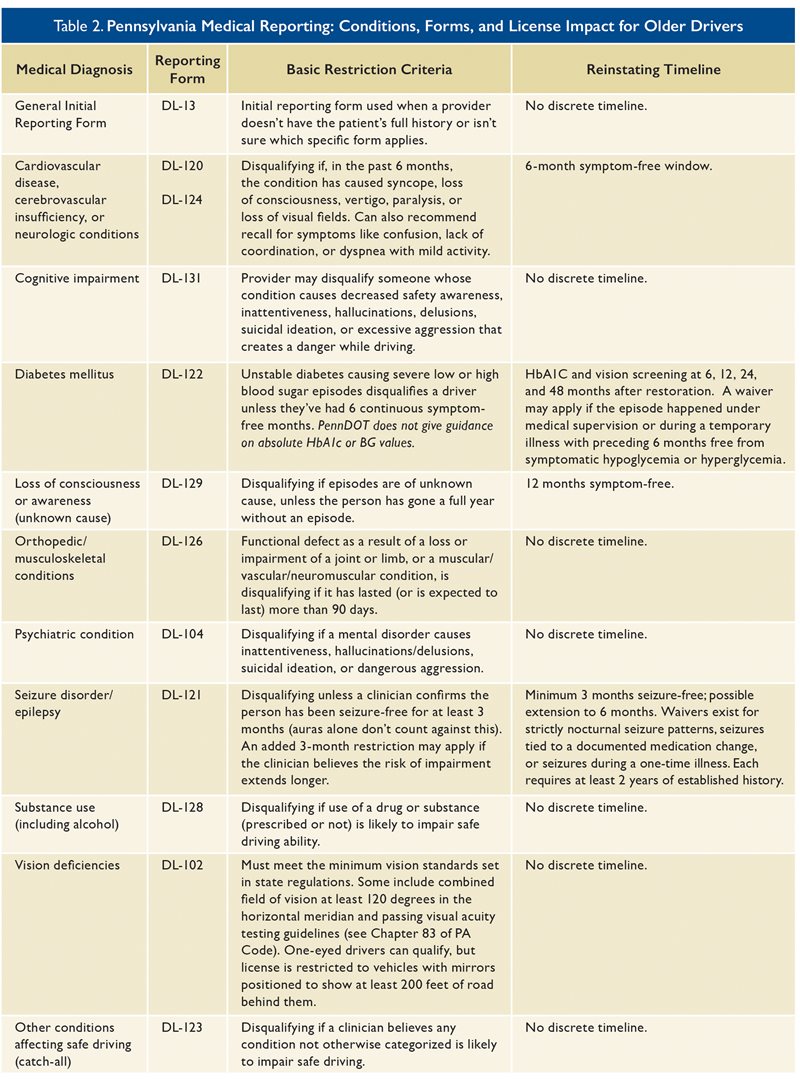
Reporting is confidential, though clinicians should inform their patients of the process to help them understand and cope with next steps (see Fig. 1). Once a report is made, PennDOT will often request more information about the patient’s health from their primary care clinician.
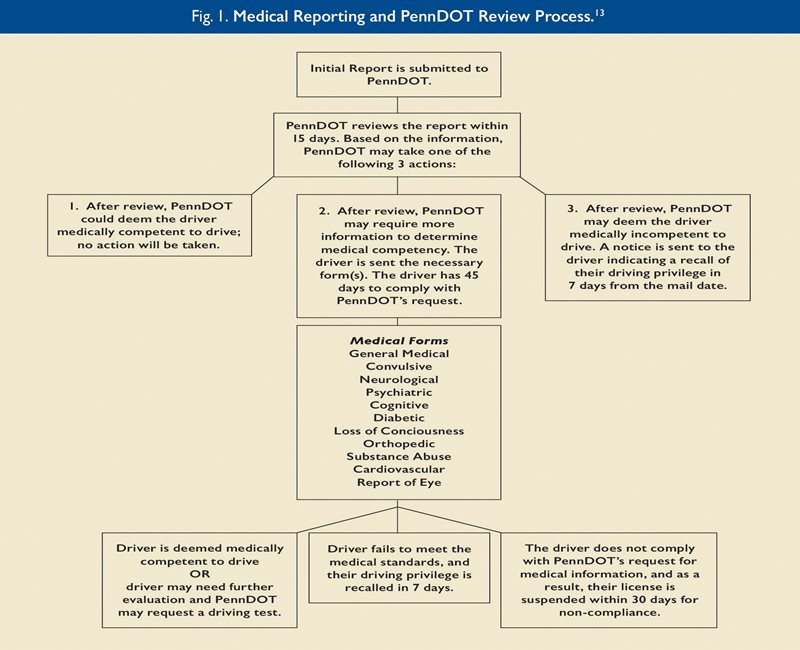 Fig. 1. Medical Reporting and PennDOT Review Process.13
It is not uncommon for PennDOT to also order their own driver’s test. If a clinician has indicated that a patient must immediately cease driving, the patient will be notified by PennDOT with a letter in the mail.
It can be helpful to discuss that PennDOT will make the final determination about whether a license is recalled or restricted. It is not uncommon for patients to transfer practices or develop symptoms consistent with depression after a license has been revoked; therefore, routine mental health screening remains important during this period.
Completion of the ALSA or behind-the-wheel exam may be difficult; it may be important to identify and address barriers to completion, such as lack of transportation to the testing center or not being able to pay the cost of testing. If no barriers are found and the evaluation has not been completed in a timely manner despite clinician concern for driving safety, a PennDOT report should be completed.
CONCLUSION
It is important to help patients maintain safe mobility as they age. Integrating routine driving safety screening and evaluation into clinical workflow using tools such as the 4Cs and CADReS provides a framework to achieve this. Maintaining therapeutic rapport, understanding local resources and reporting laws, and planning for life after driving cessation can help with the conversation and ease this challenging transition.
REFERENCES
1. Savoie C, Voyer P, Lavallière M, Bouchard S. Transition from driving to driving-cessation: experience of older persons and caregivers: a descriptive qualitative design.
BMC Geriatr. 2024;24(1):219.
2. PennDOT Reports Decline in Fatal Crashes and Traffic Deaths in 2025, Reaching Lowest Level on Record. PennDOT. April 29, 2026. Accessed June 1, 2026.
https://www.pa.gov/agencies/penndot/news-and-media/newsroom/statewide/2026/fatal-crashes-and-traffic-deaths-decline-in-2025-to-lowest-level
3. O’Connor MG, Kapust LR, Lin B, Hollis AM, Jones RN. The 4Cs (crash history, family concerns, clinical condition, and cognitive functions): a screening tool for the evaluation of the at-risk driver.
J Am Geriatr Soc. 2010;58(6):1104-1108.
4. Charlton JL, Oxley J, Fildes B, Oxley P, Newstead S. Self-regulatory behaviours of older drivers.
Annu Proc Assoc Adv Automot Med. 2003;47:181-194.
5. American Geriatrics Society, Pomidor A, eds.
Clinician’s Guide to Assessing and Counseling Older Drivers. 3rd ed. Washington, DC: National Highway Traffic Safety Administration; 2016. Report No. DOT HS 8122 228.
6. Knoefel F, Hossain S, Hsu AT. Decline in other instrumental activities of daily living as indicators of driving risk in older adults at an academic memory clinic.
Geriatrics (Basel). 2023;8(1):7.
7. Many Older Adults Take Multiple Medications; an Updated AGS Beers Criteria
® Will Help Ensure They Are Appropriate. American Geriatrics Society. May 4, 2023. Accessed August 6, 2026.
https://www.americangeriatrics.org/media-center/news/many-older-adults-take-multiple-medications-updated-ags-beers-criteriar-will-help
8. Keay L, Munoz B, Turano KA, et al. Visual and cognitive deficits predict stopping or restricting driving: the Salisbury Eye Evaluation Driving Study (SEEDS).
Invest Ophthalmol Vis Sci. 2009;50(1):107-113.
9. American Geriatrics Society. Appendix: CADReS score sheet. In Pomidor A, ed.
Clinician’s Guide to Assessing and Counseling Older Drivers. 4th ed. American Geriatrics Society; 2019:220-222.
https://www.safemobilityfl.com/pdfs/CliniciansGuide/CADReS%20Score%20Sheet%204th%20Edition.pdf
10. O’Neill D. Practice parameter update: evaluation and management of driving risk in dementia: report of the Quality Standards Subcommittee of the American Academy of Neurology.
Neurology. 2010;75(18):1659-1660.
11. Barry E, Galvin R, Keogh C, Horgan F, Fahey T. Is the Timed Up and Go test a useful predictor of risk of falls in community dwelling older adults: a systematic review and meta-analysis.
BMC Geriatr. 2014;14:14.
12. Driver and Vehicle Services Medical Reporting Forms. Commonwealth of Pennsylvania. Accessed July 16, 2026.
https://www.pa.gov/agencies/dmv/resources/medical-reporting/medical-reporting-forms
13. Medical Reporting and PennDOT Review Process. Commonwealth of Pennsylvania. Accessed July 16, 2026.
https://www.pa.gov/content/dam/copapwp-pagov/en/penndot/documents/public/dvspubsforms/bdl/bdl-medical-protected/medical%20review%20process.pdf